Welcome back to The tour guide’s English tea break,the new monthly blog that gives you the chance to relax with a tea or coffee, find out about fascinating locations from around the world, and practise useful English that you can use on your guided tour.
You can sign up to enjoy your monthly Tour guide’s English tea break for just 4€ a month.
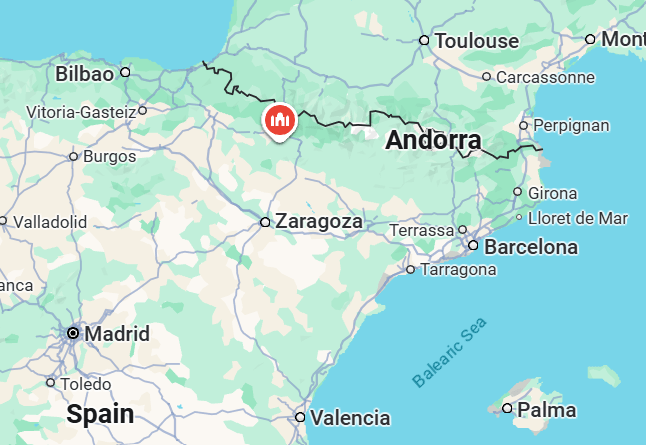
This time we are going to find out all about an astonishing monastery that was built into the side a mountain in northern Spain, and we’ll learn English for talking about conflict and instability on your tour.
Which legend is this monastery connected to, and why was it built into a rock-face in the first place? Let’s find out!
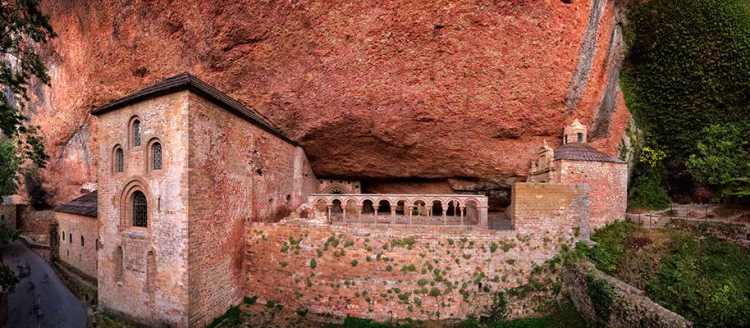
Welcome to the Monastery of San Juan de la Peña, a place where history, faith, and legend intertwine. Tucked beneath this dramatic rock overhang, the monastery is not just a marvel of architecture but a symbol of Aragón’s resilience and the wider history of Spain.
The story of this monastery begins in the 9th century, during one of Spain’s most transformative periods—the Moorish invasion. As Islamic forces swept through the Iberian Peninsula, small Christian kingdoms in the north, like Aragón, became bastions of resistance.
This secluded location made the monastery an ideal refuge, both for monks seeking a life of devotion and for a culture striving to preserve its identity. It’s a powerful reminder of the Reconquista, the centuries-long struggle by Christian kingdoms in northern Spain to reclaim their land and re-establish their faith after much of the Iberian Peninsula fell under Islamic rule following the 8th-century Moorish invasion.
You may notice how the structure merges seamlessly with its environment, almost as if it grows out of the rock itself. This was not just for protection from invaders—it was also symbolic. The integration with nature reflects the monks’ humility and their belief in a spiritual connection with the world around them. This design speaks to the medieval mindset, where religion and daily life were deeply intertwined.
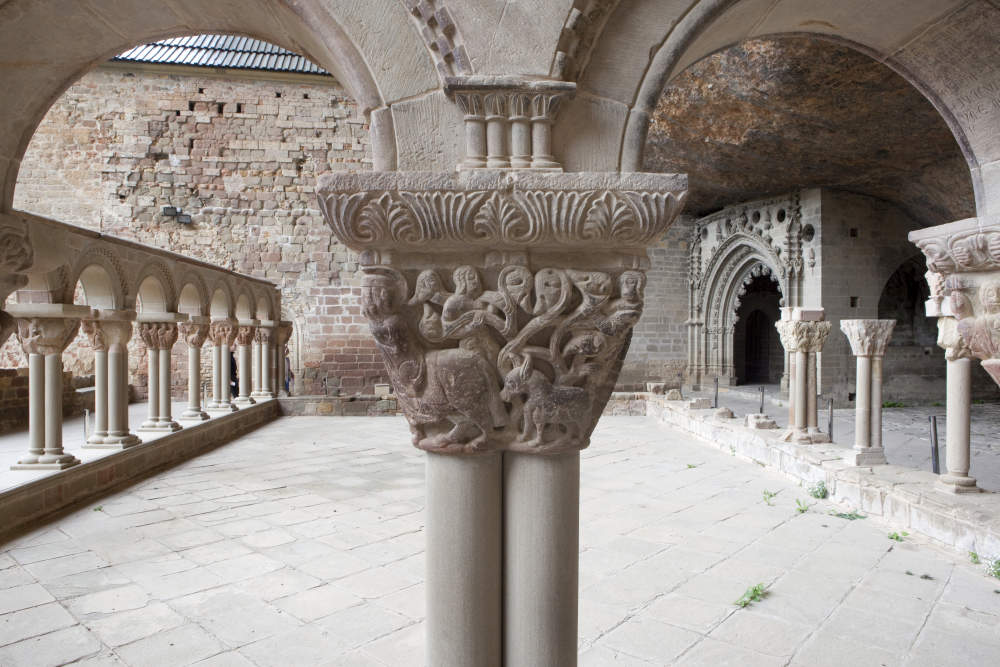
The cloister, with its carved capitals, tells stories of biblical scenes and local legends, one of the most famous being the connection to the Holy Grail. While historians debate the truth of this claim, the legend itself underscores the monastery’s spiritual importance. Pilgrims travelled here, believing it to be a sacred site, and in doing so, they reinforced Aragón’s place as a cultural and spiritual hub in medieval Spain.
This brings us to the Royal Pantheon, where early Aragonese kings are buried. Their presence here is no accident. It reflects the close relationship between church and crown, a defining feature of Spanish history. The monarchy relied on religion not only for legitimacy, but also to unify the diverse peoples of the region under a shared faith and identity.
But the monastery is also an early example of cultural exchange. During the medieval period, Spain was a land of coexistence—and conflict—between Christians, Muslims, and Jews. If you look closely, you’ll see subtle traces of Islamic art in the monastery’s decorative patterns, a reminder of the complex, interconnected history of the Iberian Peninsula.
Today, the monastery stands as a monument to Aragón’s heritage and Spain’s evolution—from a divided land of competing kingdoms to a unified nation. The fact that it has survived centuries of upheaval, including its partial destruction by fire, reflects the enduring spirit of this region.
So, we can think about this incredible place as more than just a historical site. It’s a mirror of Spain itself—shaped by conflict, faith, and the determined pursuit of identity.
What do you think?
If you visited the Monastery of San Juan de la Peña, what aspect of it would you be most interested to see?
What do you think we can learn from the way the monastery is integrated into it’s natural surroundings?
Let me know what you think in the comments below. I’d love to hear from you.
Useful English: Conflict and Instability
On walking tours it’s often important to talk about historical conflict and instability such as wars, invasions, and revolutions. This text includes a lot of useful language about this theme.
Subscribe to continue reading
Become a paid subscriber to get access to the rest of this post and other exclusive content.
Welcome to The tour guide’s English tea break,a new monthly blog that gives you the chance to relax with a tea or coffee, find out about an interesting landmark from around the world, and practise useful English that you can use on your guided tour.
The first article is about one of the icons of Oxford in England.
An iconic landmark
The Radcliffe Camera, Oxford
Radcliffe Square is a wide-open square in the centre of Oxford with imposing Gothic university buildings on each side. It’s usually busy with students on their way to lectures, and tourists taking photos. The Radcliffe Camera sits in the centre of the square dominating the skyline.
Now, “camera” might sound like a device for taking photos, but in Latin, it means “room.” And this is no ordinary room! The Radcliffe Camera was designed by the architect James Gibbs and finished in 1749. It is one of the best examples of English Palladian architecture—a style inspired by ancient Roman and Renaissance buildings.
The building is named after Dr. John Radcliffe, a famous doctor who treated royalty in the 17th century. Radcliffe was not only skilled in medicine, but also a great supporter of education. He left a large amount of money in his will to create a library that would benefit science and learning at Oxford. The Radcliffe Camera was built with this vision in mind, and it has stood as a symbol of knowledge ever since.
The first thing you’ll notice is the large dome at the top. The dome is impressive, isn’t it? It was inspired by famous buildings like St. Peter’s Basilica in Rome. It’s a symbol of learning and knowledge, which is perfect for a library!
Now look at the round shape of the building. This was very unusual in England at the time, and it makes the Radcliffe Camera stand out. The outside walls are decorated with tall columns in the Corinthian style, giving it a grand and elegant look. The stone used for the building shines golden in the sunlight, making it look warm and timeless.
The Radcliffe Camera is not only famous in real life but also on screen! You might have seen it in TV shows and films set in Oxford, like Inspector Morse, Endeavor(pictured on the right), and His Dark Materials. These programmes often use Oxford’s beautiful architecture to create an atmosphere of mystery, history, or magic. The Radcliffe Camera is one of their favourite locations.
What makes the Radcliffe Camera even more special is how it fits with the other buildings around it. Here in Radcliffe Square, it is surrounded by the Bodleian Library, All Souls College, and St. Mary’s Church. Together, they form a picture-perfect scene that many people think of when they imagine Oxford.
What do you think?
What do you think of this landmark?
What did you find interesting about it?
Can you think of any buildings that it is similar to?
How to use English: Active and passive sentences
Take a look at these two sentences. What’s the difference between them?
The Radcliffe Camera was designed by the architect James Gibbs.
James Gibbs designed the Radcliffe Camera.
Both sentences have the same meaning; the designer is James Gibbs, and the thing that he designed is the Radcliffe Camera.
The first sentence, which we read in the text, is passive. It starts with the Radcliffe Camera and the verb phrase is:
was (a form of the verb ‘be’) + designed (the past participle of the main verb)
The person who designed it, James Gibb is introduced using the word ‘by‘.
The second sentence is a normal active sentence. It starts with the person who did the action, James Gibb, followed by the verb (designed) in the past simple. At the end of the sentence we find out what he designed (the Radcliffe Camera).
When to use passive sentences
So, is it better to use an active sentence or a passive one here? Well, the main focus of our sentence should be the Radcliffe Camera. That’s what this blog post is about! So, it makes sense to use a passive sentence, which puts this landmark at the start of the sentence.
We often use passive sentences to talk about buildings or works of art when we want to focus on the landmark or piece of art itself instead of the architect or artist that designed or painted it. Active sentences are more likely to be used when we want to focus on the artist or architect.
Try it!
How many passives can you find in the text about the Radcliffe Camera?
Notice which verbs are used in the passive. Some verbs are more likely to be used in the passive then others. You might also notice how these verbs are used to focus on the Radcliffe Camera.
Can we make passives a bit shorter?
Normally, we need to include a form ofbe in a passive phrase, but we can leave it out if the passive phrase is part of a relative clause with a relative pronoun like which or that. Let’s look at an example from the text. In the example below that and was have been left out.
It is one of the best examples of English Palladian architecture—a style (that was) inspired by ancient Roman and Renaissance buildings.
Try it!
Here’s another example from the text. What words do you think have been left out?
The stone used for the building shines golden in the sunlight, making it look warm and timeless.
Answer
that/which was (used)
Now, it’s your turn!
Think of a landmark on your tour and answer these questions about it.
When was it built?
Who was it designed by?
What was the design of the landmark inspired by?
How is the facade decorated?
What is the landmark surrounded by?
How was it used at the time?
How is it used today?
Thank you for reading the first post from The tour guide’s English tea break. I hope you’ve found it useful and interesting. If you would like to find out about more interesting places and improve your English as a tour guide, then just sign up to receive more posts like this. You’ll get a new post in the last week of every month, and it only costs 4€ a month.
Many British people drink tea during their short breaks from work. Do you take tea breaks or coffee breaks?
The tour guide’s English tea break is a new monthly blog that gives you the chance to take a few minutes out of your busy day to find out about an interesting landmark from around the world and practise useful English that you can use on your tour.
New words: What’s a landmark?
A landmark is a well-known building or feature that is an important part of the landscape. Examples: Big Ben in London, Saint Peter’s Basilica in Rome, the Arc de Triomphe in Paris
It only costs 4€ a month to subscribe to The tour guide’s English tea break, but you’ll receive the first one on Monday the 27th of January for free. Here’s quick look to see what to expect!
You can
read and listen to a talk about one of the most distinctive buildings in Oxford (my hometown). Have a look at the picture below. Can you name the building?
An iconic landmark
learn how to use a vital piece of grammar to talk about the important buildings and works of art on your tour, and when to use it.
How to use English: Active and passive sentences
and, practise using the English that you have learnt to talk about the important places on your tours.
Now, it’s your turn!
Think of a landmark on your tour and…
Find out what the iconic landmark is on Monday! I hope you enjoy reading it.
You can also sign up for The tour guide’s English tea break right now to receive it every month.
It would be good to hear from you. Let me know which interesting places you would like to read about in future editions of The tour guide’s English tea break.
2024 has been a big year of learning and growth. Helping you to improve the English that you use as tour guides has been both interesting and educational. Thank you for being a part of it. We’re all busy, so thank you for taking the time to read this blog. I hope you’ve found it useful.
I hope you all have a lovely Christmas with your families, and a relaxing and well-deserved break over the Christmas holidays!
I will be back in the new year with my blog and English courses to help you to guide your tours in English.
And if you haven’t subscribed to the blog yet, you can subscribe right here. 😉
In the meantime, to help me to give you the best support that I can in the new year, please take a moment to let me know how I can help you in 2025. Thank you!
Have you ever noticed that some tours are very informative, but lack a personal touch, whereas other tours reflect the personality, experiences and opinions of the tour guide who gave it? There are a number of things that you can do to make your tours feel more personal:
Show enthusiasm for the content of the tour
Express opinions, impressions, or preferences
Share experiences relating to your tour.
We will talk about each of these in more detail later and look at examples in English with phrases that you can use yourself.
Why should you personalise your tour?
Your tour is not about you, so why is it a good idea to personalise your tour? Well, here are a few good reasons for you to think about.
Personalising your tour helps your group to:
get to know you as a person, which encourages them to ask questions and actively participate in the tour.
express their own opinions, impressions and preferences, and where necessary, to make comparisons with similar sites that they know
see the site as a part of the city instead of as a tourist attraction that is detached from the lives of the locals.
How can you personalise your tour in English?
Many tour guides find it difficult to personalise their tours in another language. This can lead to tours that are informative, but also forgettable. So, how can we personalise our tours in English? Here are some ideas and examples for you.
Showing enthusiasm
If you choose to talk about things that you find interesting, then there is no reason why you shouldn’t be enthusiastic about your tour. Many of the ways in which we show enthusiasm are non-verbal, such as our body language and the emotion in our voice. However, we can also show enthusiasm verbally.
Strong positive language
One of the most amazing things about…(the Cathedral in Milan is that it took 6 whole centuries to build.)
It may look like an ordinary square, but it has an absolutely fascinating history behind it.
Encouraging the group to use their imagination
Just imagine what it would have been like to (live here during that period of history).
Expressing opinions, impressions and preferences
I’d like to tell you about one of my favourite historical figures.
For me, it’s one of the most interesting periods of British history.
I always enjoy coming back here, not only because I find it a relaxing place to stroll, but also because it gives you a fascinating insight into what the city was like in the 19th Century.
Sharing experiences
This helps you to connect your own experience of a location to the way it is usually used by people in the city, making it more personal for your group. This can be especially useful for public areas like streets, squares, markets, and parks.
These days, it’s a popular place to socialise. I often come here to have lunch with friends at the weekend.
It was developed in the 18th Century as green space for people to relax in, and a popular park today. I used to come here a lot when I was a student just to get some peace and quiet. It hasn’t changed a great deal since then.
Useful Language
Have you noticed the useful phrases in blue in this article? Do you know what they mean? Click below to find out.
Click here!
A personal touch: Adding a personal touch to something means to make to add some details that make it personal to you.
Get to know someone: To become more familiar with someone, especially if you have met them recently. Example: We only met a few weeks ago, but I’ve got to know him quite well.
A stroll: A leisurely walk. Example: I went for a stroll around the park to stretch my legs.
Get some peace and quiet: This a phrase to talk about finding some peace and relaxation. Example: I went home and read a book to get some peace and quiet.
A great deal: A lot. Example: This square has changed a great deal over the last century.
Try it!
Try personalising your tour in English. What would you say about the locations or works of art on your tour to
Show enthusiasm?
Express opinions, impressions, or preferences?
Share your experiences relating to your tour?
Let me know. I’d love to hear about it.
If you’d like to have a chat with me about the English that you use on your tour, then send me an email at nji.swerdlow@gmail.com, or click below to choose a time to talk that’s good for you.
If you’d like to make your English tour more engaging, then let me tell you about Guide better tours in English, an English course especially for busy tour guides.
How I can help you
Many tour guides that I’ve met find it difficult to get their tour groups engaged and interested on their guided tours in English. As a teacher, I understand the importance of knowing that your group have had an interesting experience and have learnt something new.
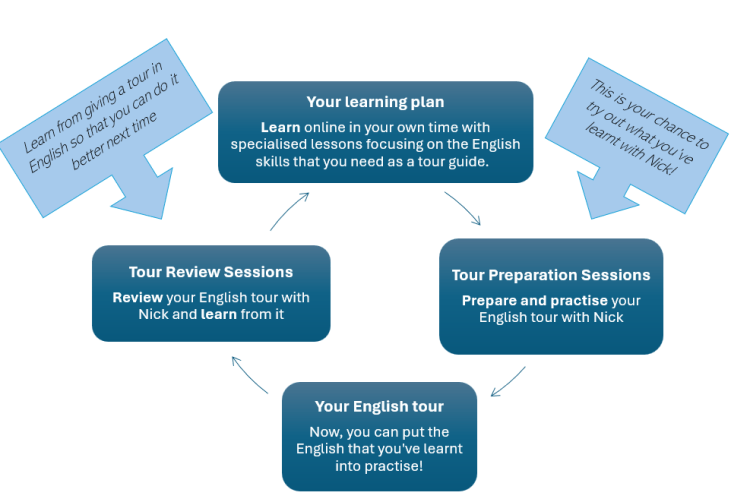
Guide better tours in English is an English course that helps you to give interesting tours in English that your tour groups feel involved in.
Busy?
I know you’re busy, so Guide better tours in English fits into your working week by combining supported learning in your own time with 1-to-1 sessions with me to prepare your English tours and learn from them afterwards.
Where can I find out more?
You can find out more on my website or book a time to have a chat with me. It would be great to speak with you.
The best way to know if a course is right for you is to try it, so here is a free lesson from Guide better tours in English so that you can see for yourself.
You probably know a lot about the items or sites on your tour, and it’s tempting to share all of your knowledge with your tour group. And why not? After all, we’d like our groups to learn as much as possible, wouldn’t we? The thing is, sharing too much information can lead to:
Spending too long talking about one site or item
Overwhelming your group with more information than they can remember
Making your group feel passive, and inactive
Sharing information that your group are not interested in
So, how do you decide what information to share with your tour group about each landmark or work of art on your tour? Let’s look at an example so that we can think about what factors to consider and practise our English at the same time.
Task
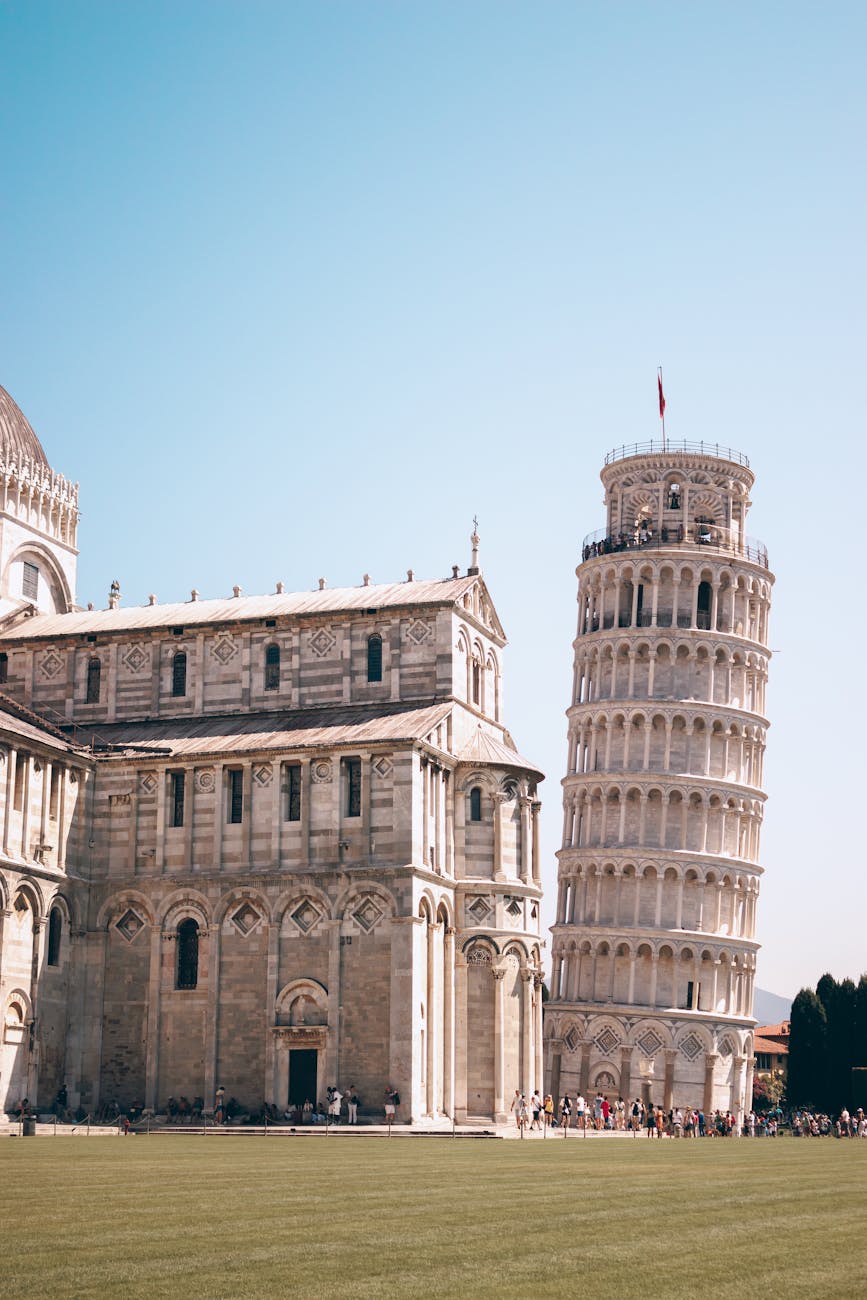
Here are 4 pieces of information about the world-famous Leaning Tower of Pisa. What do you think the words and phrases in red mean?
The Leaning Tower of Pisa
Construction of the tower began in 1173 and spanned almost two centuries. It was finally completed in 1372. The tilt began during construction as a consequence of a weak foundation and soft ground on one side, and it got worse over time.
The tower is about 56 metres tall and is composed of eight stories including the chamber for the bells at the top. It’s designed in a Romanesque style, with white and gray marble on the exterior and intricately decorated columns, arches, and walls. The columns on the exterior of the ground floor are purely decorative as part of a blind arcade.
It’s not the only leaning tower in Pisa! Due to the softness of the soil under the city, several of the towers in Pisa are leaning such as the bell tower at the church of Saint Nicholas.
By the late 20th century, the tower was leaning so severely (5.5 degrees) that engineers worried that it might collapse. After efforts to stabilise the tower were completed in 2001, the lean was reduced to 3.97 degrees, and the tower was declared stable for at least another 200 years, which is why you can climb up it today!
Click here to check your understanding of the words and phrases in red.
Span (verb/noun): To exist or continue for a length of time
Tilt (noun/verb): a leaning position
Intricately decorated (adverb + adjective): Made to look attractive using small precise details
Decorative (adjective): Something that is intended to look attractive instead of serving a function
Due to: Because of. ‘Due to’ is followed by a noun or verb + ing.
Such as: Used to give an example of something in the same sentence
Try it!
Imagine that you are going to guide a group around the Leaning Tower of Pisa.
Your Group
Your group is made up of friends in their early twenties from the UK. They’re on a back-packing trip around Italy. Most of them are at university, but none of them study a relevant subject such as history, art, architecture or engineering. Their main aim is to enjoy their holiday, but they like the idea of learning something about the place they are visiting.
Choose 3 of the 4 pieces of information to include in your talk.
Out of your remaining 3 pieces of information, which one would you spend the most time talking about?
How did you decide what to include in your talk, what to exclude, and what to focus on?
There’s no right and wrong answer to this exercise, but it’s a good reminder to think about the interests of your groups and to be selective about the information you choose to share as part of a talk. As a teacher, I’ve noticed that people are more likely to forget what they hear if they hear too much information at once without reacting to what they see and expressing their thoughts.
This does not mean that your tour should be less informative. In an interactive tour, your group can learn a lot from discussion resulting from questions that you ask them, or they ask you.
Try it!
Write 4 or 5 pieces of information about a landmark or item on your tour in English. Now, choose 3 of these pieces of information to talk about on your tour, and one of them to focus on. I’d love to hear how you decide what details to share on your tour.
If you’d like to have a chat with me about the English that you use on your tour, then click below to choose a time that’s good for you. It would be great to hear from you.
And if you found this blog useful, then why not subscribe to learn more English that you can use as a tour guide.
If you’d like to make your English tour more engaging, then let me tell you about Guide better tours in English, an English course especially for busy tour guides.
How I can help you to guide your tour in English
Many tour guides that I’ve met find it difficult to get their tour groups engaged and interested on their guided tours in English. As a teacher, I understand the importance of knowing that your group have had an interesting experience and have learnt something new.
Guide better tours in English is an English course that helps you to give interesting tours in English that your tour groups feel involved in.
Busy?
I know you’re busy, so Guide better tours in English fits into your working week by combining supported learning in your own time with 1-to-1 sessions with me to prepare your English tours and learn from them afterwards.
Where can I find out more?
You can find out more on my website or book a time to have a chat with me. It would be great to speak with you.
The best way to know if a course is right for you is to try it, so here is a free lesson from Guide better tours in English so that you can see for yourself.
Many tour guides find it more difficult to get their tour groups engaged and interested on their guided tours in English. As a teacher, I understand the importance of knowing that your group have had an interesting experience and have learnt something new.
That’s why I’ve created a new English course especially for busy tour guides. It’s called Guide better tours in English, and it helps you to give interesting tours in English that your tour groups feel involved in.
I know you’re busy, so Guide better tours in English fits into your working week by combining supported learning in your own time with 1-to-1 sessions with me to prepare your English tours and learn from them afterwards.
So that you can see what you can learn on Guide better tours in English, here is one lesson for you to try out for free!
Lesson 5: Listening to visitors’ questions
How do you feel about being asked questions in English on your tour? Is asking questions something that you actively encourage?
Receiving questions from members of your tour group can be challenging because you have to understand the question and think of a reply in English there and then. However, despite these challenges, it’s a useful skill to develop. Not only does it help your group to feel involved in the tour, it also allows them to explore their curiosities, which you might only have touched on in your talk. In this lesson you will practise listening to questions from members of your tour group and the reasons behind them, so that you are ready to respond when you ask your group…
“Would anyone like to ask any questions?”
Before listening
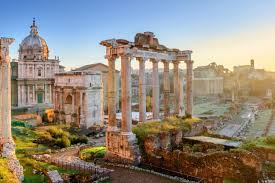
Imagine that you are on holiday in Rome and you are on a guided tour of the Roman Forum.
Write 4 questions that you would like to ask about the Roman Forum and say why you would be interested in knowing the answers to those questions.
Here are two questions asking for the same information about the Roman Forum. Read the visitor’s questions, and then answer the questions below (i – iii).
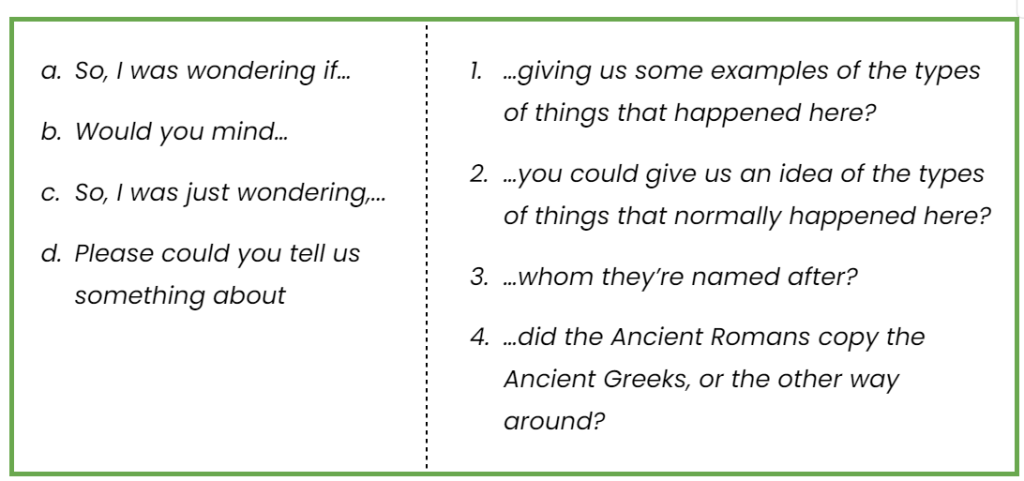
I was just thinking about what you were saying about the Roman Forum being the centre of city life in Ancient times. So, I was wondering if you could give us an idea of the types of things that normally happened here?
Would you mind giving us some examples of the types of things that happened here? I mean, it seems like the Roman Forum was the centre of city life in Ancient times, but I don’t really know what sorts of things happened here.
i. What is the difference between the sentences in red and the ones in blue?
ii. Why do you think the visitor includes the sentences in red?
iii. What phrases can you see at the start of the questions?
Listening
3. Listen to 3 visitors asking a tour guide questions about the Roman Forum. Do they ask any of your questions from exercise 1? There will be a pause between each speaker.
4. Now listen again and make notes about
The questions they ask
Their reasons for asking them
After listening
Why ask?
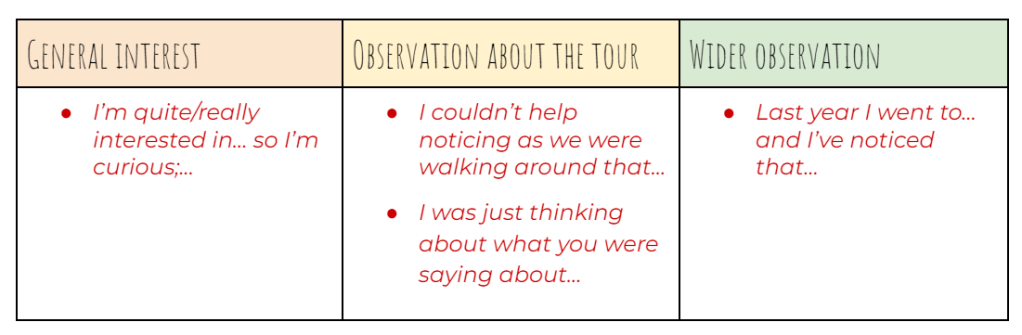
The questions that you’ve listened to and read so far have been based on three types of reasons:
Can you think of any other phrases to introduce reasons for visitors’ questions? Add them to the table.
What do you think are the most common reasons behind the questions that you are asked on your tours?
How to use a range of questions types
7. Here are the questions that you’ve read and heard so far. Match the starts and the ends of the questions.
A W/H question word followed by a sentence form (subject + verb)
A sentence form (subject + verb) about a yes or no question
Try it! Your tour
Choose two items from your tour and write at least 3 questions about each that visitors might ask you. Include reasons for asking the questions.
Do you listen to reply or listen to understand?
When people have a conversation they usually listen intently to the other speaker for long enough to decide how they are going to respond, and then they are less attentive as they wait to reply. This is why people are usually able to reply as soon as the other person finishes their turn speaking. Think about this next time you have a conversation in your own language. At what point do you decide how to reply to the other person; while they are speaking, or after they have finished speaking?
The opposite to listening to reply is listening to understand where we listen fully to everything the other person says and then think how to respond to every part of what we have heard. The advantage of this style of listening is that your mind is free to listen attentively without thinking about how to respond. Many people feel uncomfortable about pauses between speakers, but the truth is that most of us appreciate a well thought-through reply that actually responds to what we said.
Listening on English tours
So, how does this affect you on your English tour? When we listen to someone in another language like English, we usually try to do three things almost at the same time. Firstly, we need to understand what the other person is saying, then we need to decide what we want to say in response, and lastly we need to decide how to say it in that language. It’s not surprising that many people find listening to conversations in other languages challenging. I know it’s not easy from trying to have conversations in Italian!
That’s why I suggest breaking up the process into two parts. Focus on listening to what the people on your tour say or ask you to fully understand them without worrying about what you are going to say. When they have finished, think about how to respond to what they have said. As we mentioned earlier, the visitors on your tour will appreciate your response all the more if it is well thought-through and references their comments.
In today’s lesson you listened to members of a tour group asking questions and giving reasons for their questions. Your response to these types of questions should not only answer the question, but also acknowledge their reason for asking. Have a look at the example on the next page.
Example
Question 1:I’m quite interested in ancient Roman history, so I’m curious, what were the most important political events that took place in the Roman Forum?
Possible start to answer: I’m really pleased that you take an interest in the Romans.…
Try it!
How would you acknowledge their reasons for their questions at the start of your answers to them?
Question 2: Last year I went to Athens on holiday and I’ve noticed that the Roman Forum here looks pretty similar to the Parthenon in Athens, so I was just wondering,did the Ancient Romans copy the Ancient Greeks, or the other way around?
Question 3:I couldn’t help noticing as we were walking around that all of the temples have interesting names. Please could you tell us something about whom they’re named after?
What’s next on the course?
In the next lesson you can learn how to respond to questions from your tour group and give complete answers.
I hope you found this lesson useful. I’d love to hear from you. Let me know about your experience of listening to questions on English tours and answering them.
You can get started by clicking below to book your place on Guide better tours in English.
What do you do to improve your English to work as a tour guide? It may be tempting to spend time scrolling through English videos online. But how much do these videos really help you to guide a tour in English? They are chosen for you by an algorithm based on what catches your attention, which is no way to organise your own English studies for your specific needs.
The good news!
Fortunately, you’re starting from a good place! You need English for a very specific reason, and when it comes to guiding tours, you already know your stuff! You just need to be able to talk about it in English! This gives you the chance to learn some specific English that’s really going to help you in your job.
I’ve been teaching English since 2010. (Time flies!) In that time I’ve learnt a few things about how to learn languages, so in this article I’m going to give you some ideas about how you can take control of your language learning and improve the English that you use on tours in your own time by focusing on what you find difficult to do in English.
How to improve your English independently
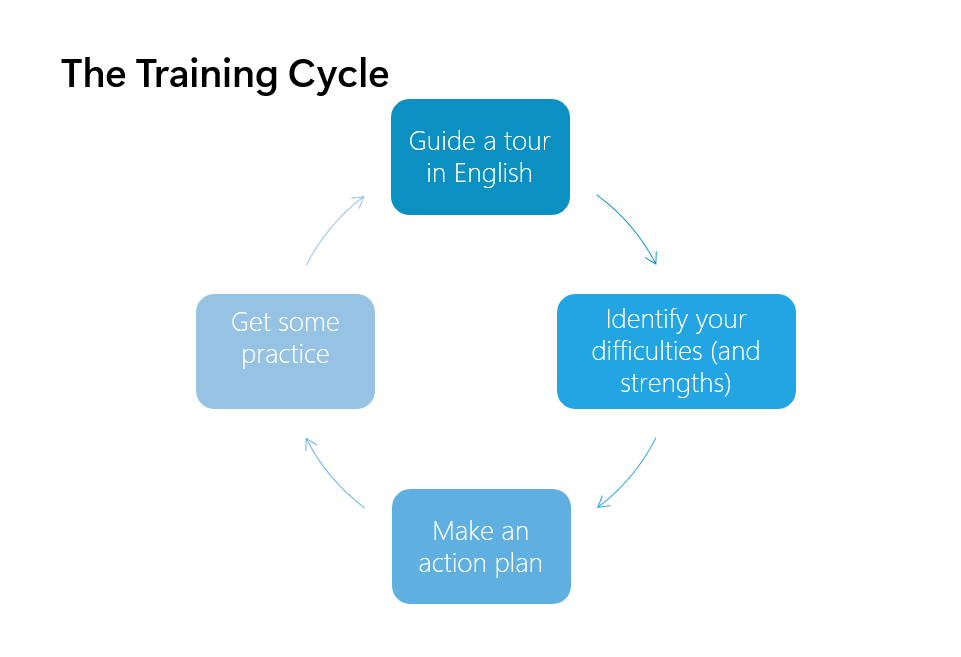
Guide a tour in English
If you want to improve the English that you use as a tour guide, you first need to understand how you use English on your tours. The best way to do this is to actually guide a tour in English and think about how it went. Start by asking your tour group for some feedback on your tour.
What did they like best about it?
How well were they able to follow the tour?
Was there anything that they didn’t understand very well?
Was there anything that they would like to know more about?
Now, spend some time thinking about your tour. Consider the following questions:
What happened on your tour?
How do you feel about how the tour went?
What do you think went well?
What could have gone better?
How did your English affect the way you gave the tour?
What did you find easier to do in English?
What did you find more difficult to do in English?
I find it helps to make some notes as you think about these questions.
Identify your difficulties (and your strengths)
Now that you’ve spent some time thinking about it, write down a list of difficulties that you have using English on your tour. The important thing here is to focus on what you find difficult to DO in English instead of what you know or don’t know in English. For example, if you think that your history of art vocabulary is not very good, that might make it difficult to explain the historical background behind works of art or to answer questions about art.
Take a look at your list. How do these difficulties affect the quality of your tours? For example,
are your tour groups able to understand and follow your tours?
do they find your tours interesting
do you they enjoy the tours?
do they learn something?
You may find that some of your difficulties with English have very little impact on your tour, whereas others have a larger effect. Which of them do you think are most important for you improve on? Choose one from your list that you would like to work on improving first.
What are you better at doing in English?
Thinking about our weaknesses can be a bit depressing, so don’t forget that you can do some things in English better than others. Think about this for a minute. What do you do well in English when you are guiding a tour? Maybe you find it easier to introduce your tour in English, or describe items on your tour before you go into more detail. Well, if you can do that well in English, then there is no reason why you can’t learn to do other things well in English too.
Make an action plan
Once you’ve identified the aspect of your English that you would like to improve, it’s time to think about how to do that. An English teacher can help you with this, but there is a lot that you can do by yourself. Here are two things that you can do in your own time.
Brainstorm it
To begin with, take advantage of the fact that you have the luxury of time to think about it. When you are giving a tour you have to express your ideas in the moment, but now that you have some time to yourself, stop and think of some better ways to express the ideas that you found difficult to say in English during your tour. If you are not sure how to say it, try asking a colleague or friend, or using an online dictionary like Collins or a language checker and rephraser like Reverso.
See how other people do it
One of the best ways to learn is to watch other people doing the same thing. Fortunately, there are usually a lot of opportunities to watch other people giving a similar tour to yours in English. You may be able to join an English-speaking tour in your area. Alternatively, there are a lot of videos of tours available on YouTube. Both options have their advantages. Watching a tour in person allows you to see how tour guides interact with tourists. Live tours are also more likely to be of the same place that you guide tours around. On the other hand, videos allow you to see the transcript of the tour and pause to make notes if you like.
The important thing in either case is to focus on the aspect of giving tours in English that you want to improve on. If you want to improve your ability to explain what the artist is trying to show then listen to how other tour guides discuss this aspect of art. Take notes on any useful language that you hear either while you listen or immediately afterwards.
Get some practice
Great! So, you’ve learnt ways to express yourself that will help you on your next tour in English. To help you remember what you’ve learnt it’s a good idea to practice using it. This will enable you to feel more confident and be more fluent when you use it on your tour. So, what can we do to practise?
Try doing a practice run of your tour or part of your tour by yourself or with a friend. It would be best to walk around the site of the tour, but if this isn’t convenient you could also do it using Google Earth, which is very detailed. Feel free to practise the aspect of your English that you are focusing on more than once.
If you show a friend around, ask him or her for some feedback on your tour.
Try it again
Yes, we’ve come back to the start of the training cycle again. It’s time to try out your new English on a real tour. Enjoy your tour, and don’t worry about trying some new English. We are aiming to make progress, not to be perfect!
After your tour, think about how it went compared to the previous one. If you feel happy with the progress that you’ve made, that’s great! Now move on and consider what other aspects of your English you need to work on. If you don’t feel like you’ve made enough progress yet, that’s absolutely fine. Have a think about what you found useful from your first training cycle, and what you should do differently. Make a new action plan and then start practising before your next English tour.
Get in touch
If you would like more ideas on how to improve your English in your own time, then book a time to have a chat with me about it. It would be great to speak to you.
And if you found this blog useful, then why not subscribe to learn more English that you can use as a tour guide.
What can I do to help you?
If you’d like to make your English tour more engaging, then let me tell you about Guide better tours in English, an English course especially for busy tour guides.
How I can help you to guide your tour in English
Many tour guides that I’ve met find it difficult to get their tour groups engaged and interested on their guided tours in English. As a teacher, I understand the importance of knowing that your group have had an interesting experience and have learnt something new.
Guide better tours in English is an English course that helps you to give interesting tours in English that your tour groups feel involved in.
Busy?
I know you’re busy, so Guide better tours in English fits into your working week by combining supported learning in your own time with 1-to-1 sessions with me to prepare your English tours and learn from them afterwards.
Where can I find out more?
You can find out more on my website or book a time to have a chat with me. It would be great to speak with you.
The best way to know if a course is right for you is to try it, so here is a free lesson from Guide better tours in English so that you can see for yourself.
The way we do exercise gives us a useful insight into how to improve our English.
I decided to repost this article because I’ve noticed that more and more of the English learners that I speak to have the same fundamental difficulty: they don’t have enough time to study English! In our busy lives this is very understandable.
The solution is to do more in English so that it becomes part of your daily routine and to manage your time so that you know when you are free to practise your English. However, it’s easier said than done, so here are some ideas on how to organise your language learning more effectively.
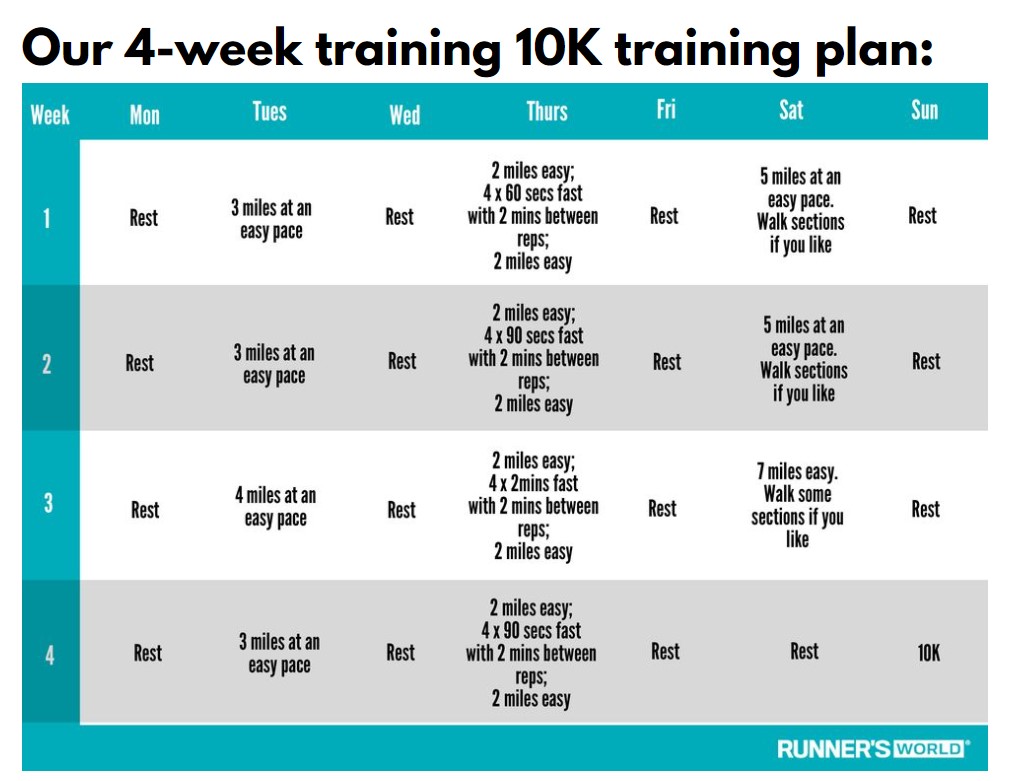
Learning a language can seem like a long road with an uncertain outcome at the end, which can make it difficult to know where to start. However, as an English teacher that enjoys running, I’ve found that there are a lot of similarities between the way we stay fit and the way we learn languages, so what can we learn from the world of exercise?
Getting started
Have you noticed that when you have a break from doing exercise for any reason, it can be difficult to get back into a routine of exercising regularly? I know from my own experience that getting started with an exercise routine is much harder than keeping it going once it has become part of your normal week.
Practising English is a bit like that. Getting into the habit of practising English regularly isn’t easy, but once you build up momentum and you can see your progress, it’s a lot easier to keep going.
So how do we get into the habit of practising our English regularly? Well, there’s a lot that we can learn from the way we do exercise.
Planning ahead
Do you have any exercise goals? I’d like to get back to running 10 kilometres without having to stop now and then to catch my breath. To do that I need to go for a run more than once a week and build up the distance that I run over time. Whether you’d like to cycle further, lift heavier weights, or get to the next level of your exercise routine, you also need to plan when you are going to do exercise, and what you’re going to do.
I’ve tried not planning ahead and the result was simple: I didn’t do any exercise because other things got in the way!
To improve your English you need to plan ahead in a similar way. Try thinking about these questions when you plan your English practice:
How often are you going to practise your English? – Have a look at your diary for your next week. Think about when you can fit English practice into your day. Try to be realistic with yourself.
How longare you going to practise your English for? – A bit like exercise, practising English can take varying lengths of time depending on what you plan to do. For example, reviewing your flashcards or your language-learning app might only take 10 minutes and fit neatly into your lunch break. Try to break your English practice into manageable chunks of time so that you don’t lose concentration.
When are you going to practise your English? – Look at your diary. When do you have time to practise English? Also think about how you normally feel at different times of the day. If you are a morning-person, perhaps you can fit in English practice before work. If you always feel tired after work, you might need a break before practising your English.
What if something comes up? – It’s incredibly easy to do. You have the best of intentions to spend some time practising your English, and then something comes up. Maybe your boss asks you to work, or your friend calls to chat because they have a problem. In the end, it’s difficult to say ‘no’, so try to have a substitute time when you can practise your English instead, just in case something comes up.
What are you going to practise? – Deciding what to practise isn’t as easy as it sounds. Try making lists of
things you find difficult to do in English
things you need to do in English
things you want to be able to do in English
Reviewing what you’ve learnt is a good idea, but try to practise a range of different English skills during the week.
Now try to write a plan of what you are going to do in each of your exercise sessions during the week. You can use a diary, but I find that an online calendar like Google Calendar works well for this because you receive reminders.
You don’t have to go to the gym to lead an active lifestyle
As wonderful as going to the gym is, there are other ways to stay active. You can fit activity into your daily routine by cycling to work for example.
Similarly, you can also make English part of your daily routine. Just like you swap your car for your bike, you can also start to do some of your daily activities in English instead of your own language. Here are some examples:
Staying in and watching TV: Try watching something in English with English subtitles if you like. These days streaming services like Netflix make this a lot easier. If you find it tiring to watch a full film in English, then watch shorter episode of a TV show. Films and TV series can be difficult to follow, so you might like to try a TV show that you’ve seen before in your language, or one with a more predictable format where the pictures help you to understand what is happening.
English for work: If you need to improve your English for your job, try watching English videos online related to your work so that you can learn the professional English that you need.
Having a chat with friends: Get in touch with someone you know who doesn’t speak your language. If it’s difficult to think of someone suitable, you might like to look for someone on social media whom you can practise speaking English with. You could help them to practise speaking your language in return.
Use the internet in English: Try changing your language settings to English for your computer, Google, and your favourite websites. Next time you buy something on Amazon, you could read about the product and check the reviews in English!
And don’t forget these are learning opportunities, so try to make the most of them. After you’ve finished watching TV, find out what that phrase that you didn’t quite understand means, and how you can use it. When you talk to someone in English, try to use that new expression that you learnt recently. Their reaction will help you understand whether you are using it correctly.
Give yourself a goal!
A few years ago I used to run 10km in under 50 minutes, so I’m aiming to get back to doing 10km runs in those kinds of times. Having a goal helps me in a few different ways.
Motivation: It’s motivating because you have a clear and precise idea of what you want to achieve, and you know when you’ve achieved it.
Steps: If you have a goal, you can then decide what steps you need to take to achieve it
Reflection: Having a goal allows you to reflect on what progress you have made so far to achieve it. It is difficult to do this if you don’t know what you are aiming to achieve.
What makes a good language-learning goal?
The problem with a general goal of improving your English is that, unlike timing a run, it’s almost impossible to say when you’ve achieved it. Think about these questions; How much do you want to improve your English by? What will your English look like when it has improved? How will you know when you’ve got to this point?
You might decide that you want to learn 20 new words each week. This goal is a bit easier to measure, but has nothing to do with how you would like to use your English. Think about why you want to improve your English in the first place. What would you like to be able to do with your English that would help you in your life? Now try to make goals based on that. Here are a few ideas of clear goals that relate to our lives to help you think about what you’d like to achieve with your English:
Making a presentation in English at work and respond to questions about it
Watching your favourite TV show in English without following the subtitles
Taking part in a group conversation in English following the conversation and participating appropriately
I’m sure you can think of English goals that relate to your life. Whatever they are, try to make them as clearly defined as possible so that you know when you have achieved your goal. Once you have a goal, work backwards and decide what steps you need to take to achieve it. Set your self short-term goals to help you on your way.
Sometimes it helps to talk about your English goals and how to achieve them. I’ have a lot of experience of helping language learners to develop their English to make the most of their opportunities, and I would love to hear about why you would like to improve your English.
If you’d like to make your English tour more engaging, then let me tell you about Improve your English tour as you work, an English course especially for busy tour guides.
Why Improve your English as you work?
Many tour guides that I’ve met find it difficult to get their tour groups engaged and interested on their guided tours in English. As a teacher, I understand the importance of knowing that your group have had an interesting experience and have learnt something new.
Improve your English tour as you work is an English course that helps you to give interesting tours in English that your tour groups feel involved in.
Busy?
I know you’re busy, so Improve your English tour as you work fits into your working week by combining supported learning in your own time with 1-to-1 sessions with me to prepare your English tours and learn from them afterwards.
Where can I find out more?
You can find out more on my website or book a time to have a chat with me. It would be great to speak with you.
The best way to know if a course is right for you is to try it, so here is a free lesson from Improve your English tour as you work so that you can see for yourself.
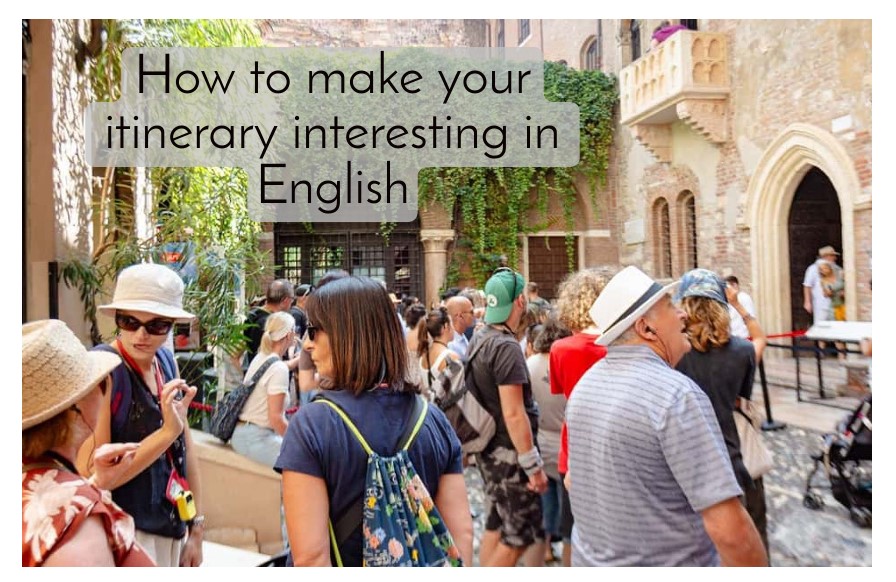
Outlining the itinerary of your tour is important. It helps your tour group to know what to expect and to get excited about the tour. To make your itinerary exciting it should be more than just a list of places to visit, it should leave the group looking forward to visiting them. In this article we’ll think about the English that we need to do this.
At the start of your tour, you will need to introduce yourself, thank the group for coming, and introduce the tour as a whole before you go through your itinerary with them. If you would like to know more about how to introduce yourself to your tour group in English then you can read my article on it, which is full of tips and useful English that you can use when you start your tour.
We’re going to look at an example of a tour guide giving an overview of a tour of Verona, a city that I had the pleasure of visiting many years ago when I was backpacking around Italy. In our example, we’ll see the type of English that we need to use to make our itineraries more interesting.
Read the overview of the tour of Verona. Which of the places would you find most interesting to visit?
Introduction
Good morning everyone! My name’s Nick, and I’ll be your tour guide for our enjoyable walk around the beautiful city of Verona. First of all, I want to thank you all for joining us for this tour. We have an incredible experience lined up, filled with fas________ sights, ri__ history, and won______ memories to be made.
Itinerary Overview
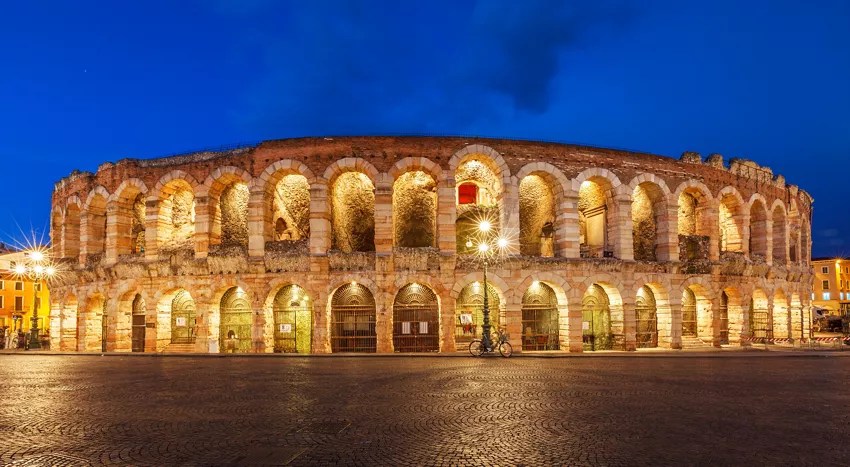
We’ll start with a visit to the ic_____ Arena di Verona, one of the best-pr_______ ancientRoman amphitheatres. Here, you’ll have the chance to learn about its history and significance.
After that, we’ll head to Piazza delle Erbe, Verona’s oldest square, where you can admire the beautiful architecture and li____ market. You’ll have some free time to explore and perhaps grab a coffee or a gelato.
Afterwards, we’ll visit la Casa di Giulietta (Juliet’s House) to see the famous balcony from Shakespeare’s Romeo and Juliet. Our final stop will be at the Castelvecchio Museum, a stu_____ medieval castle with an impr______ art collection.
Of course, the itinerary of your tour is just one part of your introduction. There is a lot of other information that you may need to include when you introduce your tour such as how long it will take. However, in this article we will focus on the English that we need to make our itinerary interesting for our tour group.
Describing landmarks with adjectives
Using adjectives is a great way to get your group interested in your tour. What do you think the missing adjectives are in the introduction and itinerary overview?
Now listen to the itinerary overview and check your answers.
The answers
fascinating sights
rich history
wonderful memories
the iconic Arena di Verona
one of the best-preserved ancient Roman Amphitheatres
a lively market
delicious local cuisine
a stunning medieval castle
an impressive art collection
These adjectives are useful because they are commonly used together with the types of nouns that you need to use to talk about your itinerary, but other adjectives are also possible. Maybe you can think of some of them.
How to use them
If you would like to start using these adjectives, you need to know more than their basic meaning. It’s also important to understand what they are often used to describe, so here’s a useful table to help you to understand how you can use these adjectives to give an overview of your itinerary. The blue links will take you to an online dictionary where you can listen to the pronunciation of these adjectives.
Something that impresses you because of the skill required to do it or because of how big it is. Note: Impressive is only used in a positive sense.
art collection architecture skill achievement range of…
Try it!
Think of the tours that you have been involved in. Can you think of an example of
A landmark with a fascinating history behind it?
A region that has maintained a rich culture of local cuisine?
A tour group that went home with some wonderful memories?
An iconic landmark?
A well-preserved structure that dates back to ancient times?
A part of town with a lively atmosphere?
A vantage point with stunning panoramic views?
A museum with a truly impressive collection of art?
Let’s have a chat about it. I’d love to hear about your examples. You can email me at nji.swerdlow@gmail.com, or click on the link below to book a time to have a chat.
Let’s see how we can use these adjectives to make our itinerary sound more interesting and exciting. Take a look at how the Piazza delle Erbe (pictured above) is described in the itinerary for our tour of Verona.
After that, we’ll head to Piazza delle Erbe, Verona’s oldest square, where you can admire the beautiful architecture and lively market. You’ll have some free time to explore and perhaps grab a coffee or a gelato.
The tour guide tells the group four things about the place that they are going to visit.
What its name is
What it is
What you can see there
What you can dothere
The first three of these pieces of information neatly fit into one sentence. The tour guide adds detail about the Piazza delle Erbe in two ways. Firstly, he uses commas (,) to briefly explain what the Piazza delle Erbe is. Secondly, he tells the group what they can see using a relative clause starting with where to talk about a place where something happens. We can use which to explain what a landmark is. Let’s have a look at an example about the Arena di Verona.
Today, we’ll start with a visit to the iconic Arena di Verona, which is one of the best-preserved ancientRoman amphitheatres.
Don’t forget to pause!
As you can see, there are also commas before the relative pronouns (where and which) because we are adding extra information about each landmark, which helps you to know when to pause and take a breath when you are speaking.
Try it!
Try reading the description of the Piazza delle Erbe out loud twice. Firstly, read it all the way through without pausing. Now, read it again and pause where you see commas or full stops (.).
Notice how much easier it is to speak fluently if you have natural pauses in your speech. It’s also easier for your tour group to follow what you are saying when they listen to you. By the way, this is true in your language too!
In this article we’ve looked at
Adjectives that are useful for describing places on your itinerary.
A structure that helps you to make your itinerary more interesting
How to add detail to your description of landmarks
The importance of natural pauses when we are speaking
Try it!
Using what you have learnt in this article, introduce a landmark on your tour itinerary using the structure that we saw earlier. Try using these ideas to make your itinerary more interesting and exciting next time you give an overview of it to a tour group.
Let me know how you introduce the places on your tour itinerary. I’d love to hear from you. You can email me at nji.swerdlow@gmail.com or book a time to have a chat with me using the link below.
I hope you’ve found this article useful. If you have, please like it, subscribe for more articles like it, and if you think it would help a friend or colleague, then share it with them. I’d really appreciate it!
What else can I do to help you?
If you’d like to make your English tour more engaging, then let me tell you about Guide better tours in English, an English course especially for busy tour guides.
How I can help you to improve your English tours
Many tour guides that I’ve met find it difficult to get their tour groups engaged and interested on their guided tours in English. As a teacher, I understand the importance of knowing that your group have had an interesting experience and have learnt something new.
Guide better tours in English is an English course that helps you to give interesting tours in English that your tour groups feel involved in.
Busy?
I know you’re busy, so Guide better tours in English fits into your working week by combining supported learning in your own time with 1-to-1 sessions with me to prepare your English tours and learn from them afterwards.
Where can I find out more?
You can find out more on my website or book a time to have a chat with me. It would be great to speak with you.
The best way to know if a course is right for you is to try it, so here is a free lesson from Guide better tours in English so that you can see for yourself.

























 Nick Swerdlow