
You probably know a lot about the items or sites on your tour, and it’s tempting to share all of your knowledge with your tour group. And why not? After all, we’d like our groups to learn as much as possible, wouldn’t we? The thing is, sharing too much information can lead to:
- Spending too long talking about one site or item
- Overwhelming your group with more information than they can remember
- Making your group feel passive, and inactive
- Sharing information that your group are not interested in
So, how do you decide what information to share with your tour group about each landmark or work of art on your tour? Let’s look at an example so that we can think about what factors to consider and practise our English at the same time.
Task
Here are 4 pieces of information about the world-famous Leaning Tower of Pisa. What do you think the words and phrases in red mean?
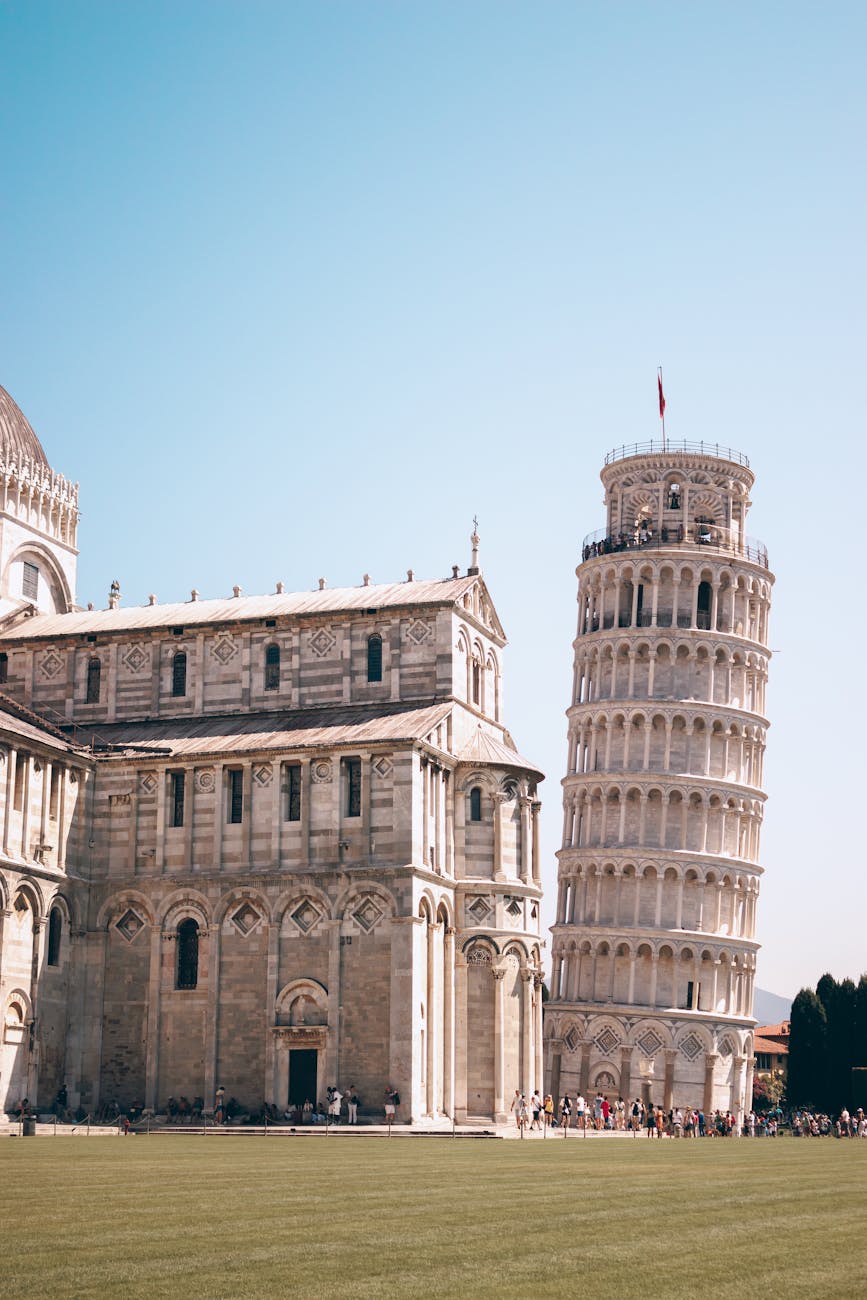
The Leaning Tower of Pisa
- Construction of the tower began in 1173 and spanned almost two centuries. It was finally completed in 1372. The tilt began during construction as a consequence of a weak foundation and soft ground on one side, and it got worse over time.
- The tower is about 56 metres tall and is composed of eight stories including the chamber for the bells at the top. It’s designed in a Romanesque style, with white and gray marble on the exterior and intricately decorated columns, arches, and walls. The columns on the exterior of the ground floor are purely decorative as part of a blind arcade.
- It’s not the only leaning tower in Pisa! Due to the softness of the soil under the city, several of the towers in Pisa are leaning such as the bell tower at the church of Saint Nicholas.
- By the late 20th century, the tower was leaning so severely (5.5 degrees) that engineers worried that it might collapse. After efforts to stabilise the tower were completed in 2001, the lean was reduced to 3.97 degrees, and the tower was declared stable for at least another 200 years, which is why you can climb up it today!
Click here to check your understanding of the words and phrases in red.
Span (verb/noun): To exist or continue for a length of time
Tilt (noun/verb): a leaning position
Intricately decorated (adverb + adjective): Made to look attractive using small precise details
Decorative (adjective): Something that is intended to look attractive instead of serving a function
Due to: Because of. ‘Due to’ is followed by a noun or verb + ing.
Such as: Used to give an example of something in the same sentence
Try it!
Imagine that you are going to guide a group around the Leaning Tower of Pisa.
Your Group
Your group is made up of friends in their early twenties from the UK. They’re on a back-packing trip around Italy. Most of them are at university, but none of them study a relevant subject such as history, art, architecture or engineering. Their main aim is to enjoy their holiday, but they like the idea of learning something about the place they are visiting.
- Choose 3 of the 4 pieces of information to include in your talk.
- Out of your remaining 3 pieces of information, which one would you spend the most time talking about?
- How did you decide what to include in your talk, what to exclude, and what to focus on?
There’s no right and wrong answer to this exercise, but it’s a good reminder to think about the interests of your groups and to be selective about the information you choose to share as part of a talk. As a teacher, I’ve noticed that people are more likely to forget what they hear if they hear too much information at once without reacting to what they see and expressing their thoughts.
This does not mean that your tour should be less informative. In an interactive tour, your group can learn a lot from discussion resulting from questions that you ask them, or they ask you.
Try it!
Write 4 or 5 pieces of information about a landmark or item on your tour in English. Now, choose 3 of these pieces of information to talk about on your tour, and one of them to focus on. I’d love to hear how you decide what details to share on your tour.
If you’d like to have a chat with me about the English that you use on your tour, then click below to choose a time that’s good for you. It would be great to hear from you.
And if you found this blog useful, then why not subscribe to learn more English that you can use as a tour guide.
If you’d like to make your English tour more engaging, then let me tell you about Guide better tours in English, an English course especially for busy tour guides.
How I can help you to guide your tour in English
Many tour guides that I’ve met find it difficult to get their tour groups engaged and interested on their guided tours in English. As a teacher, I understand the importance of knowing that your group have had an interesting experience and have learnt something new.
Guide better tours in English is an English course that helps you to give interesting tours in English that your tour groups feel involved in.
Busy?
I know you’re busy, so Guide better tours in English fits into your working week by combining supported learning in your own time with 1-to-1 sessions with me to prepare your English tours and learn from them afterwards.
Where can I find out more?
You can find out more on my website or book a time to have a chat with me. It would be great to speak with you.
Start learning for free!
The best way to know if a course is right for you is to try it, so here is a free lesson from Guide better tours in English so that you can see for yourself.
 Nick Swerdlow
I want to unsuscribe from newsletter please Ilenia
LikeLike