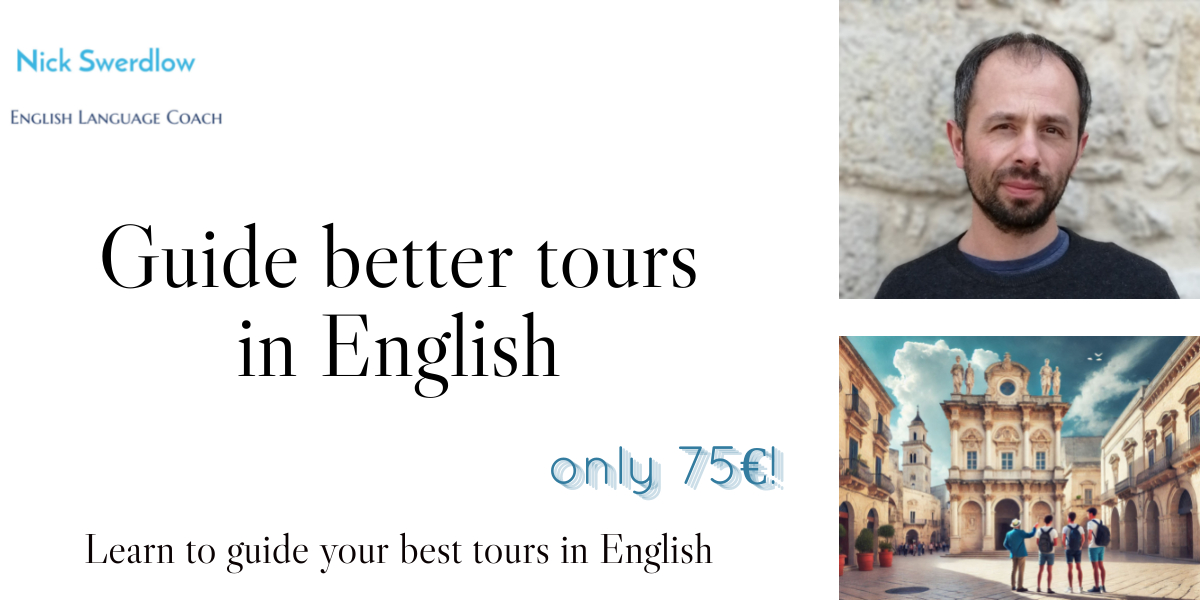
Many tour guides find it more difficult to get their tour groups engaged and interested on their guided tours in English. As a teacher, I understand the importance of knowing that your group have had an interesting experience and have learnt something new.
That’s why I’ve created a new English course especially for busy tour guides. It’s called Guide better tours in English, and it helps you to give interesting tours in English that your tour groups feel involved in.
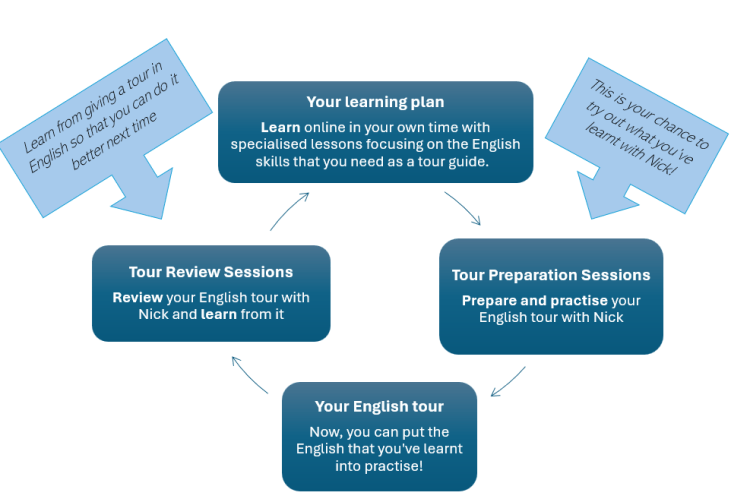
I know you’re busy, so Guide better tours in English fits into your working week by combining supported learning in your own time with 1-to-1 sessions with me to prepare your English tours and learn from them afterwards.
So, how does it work?
Like all the best ideas, it’s simple!
So that you can see what you can learn on Guide better tours in English, here is one lesson for you to try out for free!
Lesson 5: Listening to visitors’ questions

How do you feel about being asked questions in English on your tour? Is asking questions something that you actively encourage?
Receiving questions from members of your tour group can be challenging because you have to understand the question and think of a reply in English there and then. However, despite these challenges, it’s a useful skill to develop. Not only does it help your group to feel involved in the tour, it also allows them to explore their curiosities, which you might only have touched on in your talk. In this lesson you will practise listening to questions from members of your tour group and the reasons behind them, so that you are ready to respond when you ask your group…
“Would anyone like to ask any questions?”
Before listening
Imagine that you are on holiday in Rome and you are on a guided tour of the Roman Forum.

- Write 4 questions that you would like to ask about the Roman Forum and say why you would be interested in knowing the answers to those questions.
- Here are two questions asking for the same information about the Roman Forum. Read the visitor’s questions, and then answer the questions below (i – iii).
- I was just thinking about what you were saying about the Roman Forum being the centre of city life in Ancient times. So, I was wondering if you could give us an idea of the types of things that normally happened here?
- Would you mind giving us some examples of the types of things that happened here? I mean, it seems like the Roman Forum was the centre of city life in Ancient times, but I don’t really know what sorts of things happened here.
i. What is the difference between the sentences in red and the ones in blue?
ii. Why do you think the visitor includes the sentences in red?
iii. What phrases can you see at the start of the questions?
Listening
3. Listen to 3 visitors asking a tour guide questions about the Roman Forum. Do they ask any of your questions from exercise 1? There will be a pause between each speaker.
4. Now listen again and make notes about
- The questions they ask
- Their reasons for asking them
After listening
Why ask?
The questions that you’ve listened to and read so far have been based on three types of reasons:
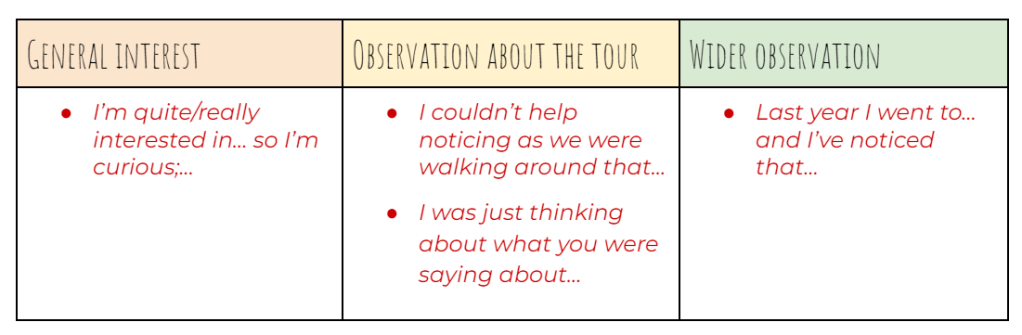
- Can you think of any other phrases to introduce reasons for visitors’ questions? Add them to the table.
- What do you think are the most common reasons behind the questions that you are asked on your tours?
How to use a range of questions types
7. Here are the questions that you’ve read and heard so far. Match the starts and the ends of the questions.
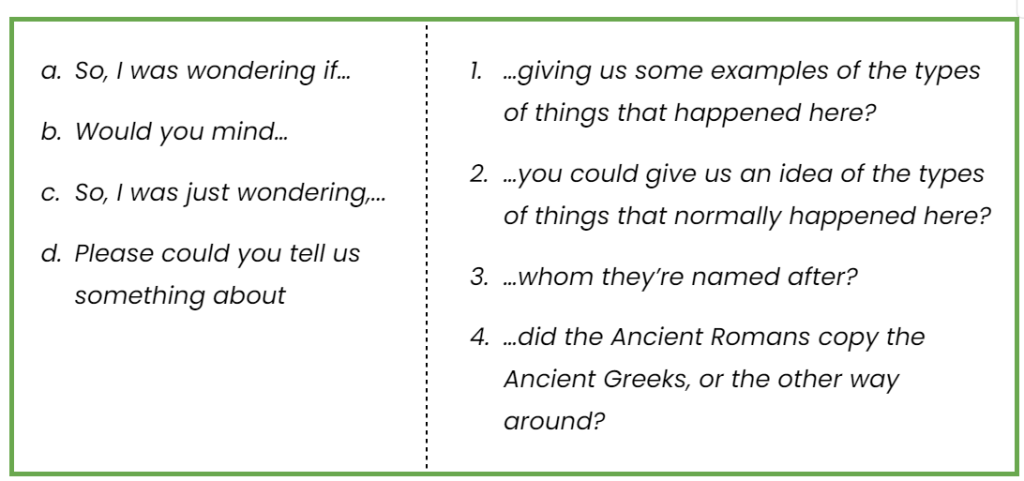
- Check your answers by reading the questions in exercise 2 and listening to the questions in exercise 3.
- Which of the starts of questions is followed by
- Verb+ing
- A question form
- A W/H question word followed by a sentence form (subject + verb)
- A sentence form (subject + verb) about a yes or no question
Try it! Your tour
- Choose two items from your tour and write at least 3 questions about each that visitors might ask you. Include reasons for asking the questions.
Do you listen to reply or listen to understand?
When people have a conversation they usually listen intently to the other speaker for long enough to decide how they are going to respond, and then they are less attentive as they wait to reply. This is why people are usually able to reply as soon as the other person finishes their turn speaking. Think about this next time you have a conversation in your own language. At what point do you decide how to reply to the other person; while they are speaking, or after they have finished speaking?
The opposite to listening to reply is listening to understand where we listen fully to everything the other person says and then think how to respond to every part of what we have heard. The advantage of this style of listening is that your mind is free to listen attentively without thinking about how to respond. Many people feel uncomfortable about pauses between speakers, but the truth is that most of us appreciate a well thought-through reply that actually responds to what we said.
Listening on English tours
So, how does this affect you on your English tour? When we listen to someone in another language like English, we usually try to do three things almost at the same time. Firstly, we need to understand what the other person is saying, then we need to decide what we want to say in response, and lastly we need to decide how to say it in that language. It’s not surprising that many people find listening to conversations in other languages challenging. I know it’s not easy from trying to have conversations in Italian!
That’s why I suggest breaking up the process into two parts. Focus on listening to what the people on your tour say or ask you to fully understand them without worrying about what you are going to say. When they have finished, think about how to respond to what they have said. As we mentioned earlier, the visitors on your tour will appreciate your response all the more if it is well thought-through and references their comments.
In today’s lesson you listened to members of a tour group asking questions and giving reasons for their questions. Your response to these types of questions should not only answer the question, but also acknowledge their reason for asking. Have a look at the example on the next page.
Example
Question 1: I’m quite interested in ancient Roman history, so I’m curious, what were the most important political events that took place in the Roman Forum?
Possible start to answer: I’m really pleased that you take an interest in the Romans.…
Try it!
How would you acknowledge their reasons for their questions at the start of your answers to them?
Question 2: Last year I went to Athens on holiday and I’ve noticed that the Roman Forum here looks pretty similar to the Parthenon in Athens, so I was just wondering, did the Ancient Romans copy the Ancient Greeks, or the other way around?
Question 3: I couldn’t help noticing as we were walking around that all of the temples have interesting names. Please could you tell us something about whom they’re named after?
What’s next on the course?
In the next lesson you can learn how to respond to questions from your tour group and give complete answers.
I hope you found this lesson useful. I’d love to hear from you. Let me know about your experience of listening to questions on English tours and answering them.
You can get started by clicking below to book your place on Guide better tours in English.
If you would like to know more about it then take a look at my website or book a time to have a chat with me. It would be great to speak with you.


 Nick Swerdlow
7 thoughts on “How to guide better tours in English”