Outlining the itinerary of your tour is important. It helps your tour group to know what to expect and to get excited about the tour. To make your itinerary exciting it should be more than just a list of places to visit, it should leave the group looking forward to visiting them. In this article we’ll think about the English that we need to do this.
At the start of your tour, you will need to introduce yourself, thank the group for coming, and introduce the tour as a whole before you go through your itinerary with them. If you would like to know more about how to introduce yourself to your tour group in English then you can read my article on it, which is full of tips and useful English that you can use when you start your tour.
We’re going to look at an example of a tour guide giving an overview of a tour of Verona, a city that I had the pleasure of visiting many years ago when I was backpacking around Italy. In our example, we’ll see the type of English that we need to use to make our itineraries more interesting.
Read the overview of the tour of Verona. Which of the places would you find most interesting to visit?
Introduction
Good morning everyone! My name’s Nick, and I’ll be your tour guide for our enjoyable walk around the beautiful city of Verona. First of all, I want to thank you all for joining us for this tour. We have an incredible experience lined up, filled with fas________ sights, ri__ history, and won______ memories to be made.
Itinerary Overview
We’ll start with a visit to the ic_____ Arena di Verona, one of the best-pr_______ ancient Roman amphitheatres. Here, you’ll have the chance to learn about its history and significance.
After that, we’ll head to Piazza delle Erbe, Verona’s oldest square, where you can admire the beautiful architecture and li____ market. You’ll have some free time to explore and perhaps grab a coffee or a gelato.
Afterwards, we’ll visit la Casa di Giulietta (Juliet’s House) to see the famous balcony from Shakespeare’s Romeo and Juliet. Our final stop will be at the Castelvecchio Museum, a stu_____ medieval castle with an impr______ art collection.
Of course, the itinerary of your tour is just one part of your introduction. There is a lot of other information that you may need to include when you introduce your tour such as how long it will take. However, in this article we will focus on the English that we need to make our itinerary interesting for our tour group.
Describing landmarks with adjectives
Using adjectives is a great way to get your group interested in your tour. What do you think the missing adjectives are in the introduction and itinerary overview?
Now listen to the itinerary overview and check your answers.
The answers
- fascinating sights
- rich history
- wonderful memories
- the iconic Arena di Verona
- one of the best-preserved ancient Roman Amphitheatres
- a lively market
- delicious local cuisine
- a stunning medieval castle
- an impressive art collection
These adjectives are useful because they are commonly used together with the types of nouns that you need to use to talk about your itinerary, but other adjectives are also possible. Maybe you can think of some of them.
How to use them
If you would like to start using these adjectives, you need to know more than their basic meaning. It’s also important to understand what they are often used to describe, so here’s a useful table to help you to understand how you can use these adjectives to give an overview of your itinerary. The blue links will take you to an online dictionary where you can listen to the pronunciation of these adjectives.
| Adjective | Pronunciation | Meaning | Nouns that it is commonly used with |
| Fascinating | /fæsɪneɪtɪŋ/ Note: the ‘c’ is silent | Very interesting | sights insight into s.th look at s.th history story |
| Rich | /rɪtʃ/ Note: the ‘i’ is a short sound as in ‘big’ | Interesting because it is full of different events. | history culture tradition |
| Wonderful | /wʌndəʳfʊl/ | Very good | memories experience place to eat/visit views |
| Iconic | /aɪkɒnɪk/ Note: the first ‘i’ is an /aɪ/ sound like eye, my or like. | Very important or impressive as a symbol of something | amphitheatre landmark building historical figure painting image statue |
| Best/Well-preserved | /wel-prezɜ:vd/ | Kept in good condition over a long period of time | amphitheatre fossils ancient remains fresco castle monument |
| Lively | /laɪvli/ Note: the ‘i’ is an /aɪ/ sound like eye, my or like. This is different from the pronunciation of the ‘i’ in the verb ‘live’ /lɪv/ | a place or event where a lot of interesting and exciting things happen | market atmosphere bar nightlife part of town |
| Stunning | /stʌnɪŋ/ | Absolutely beautiful or very impressive | castle architecture views setting palace scenery artwork |
| Impressive | /ɪmpresɪv/ | Something that impresses you because of the skill required to do it or because of how big it is. Note: Impressive is only used in a positive sense. | art collection architecture skill achievement range of… |
Try it!
Think of the tours that you have been involved in. Can you think of an example of
- A landmark with a fascinating history behind it?
- A region that has maintained a rich culture of local cuisine?
- A tour group that went home with some wonderful memories?
- An iconic landmark?
- A well-preserved structure that dates back to ancient times?
- A part of town with a lively atmosphere?
- A vantage point with stunning panoramic views?
- A museum with a truly impressive collection of art?
Let’s have a chat about it. I’d love to hear about your examples. You can email me at nji.swerdlow@gmail.com, or click on the link below to book a time to have a chat.
Adding colour to your itinerary

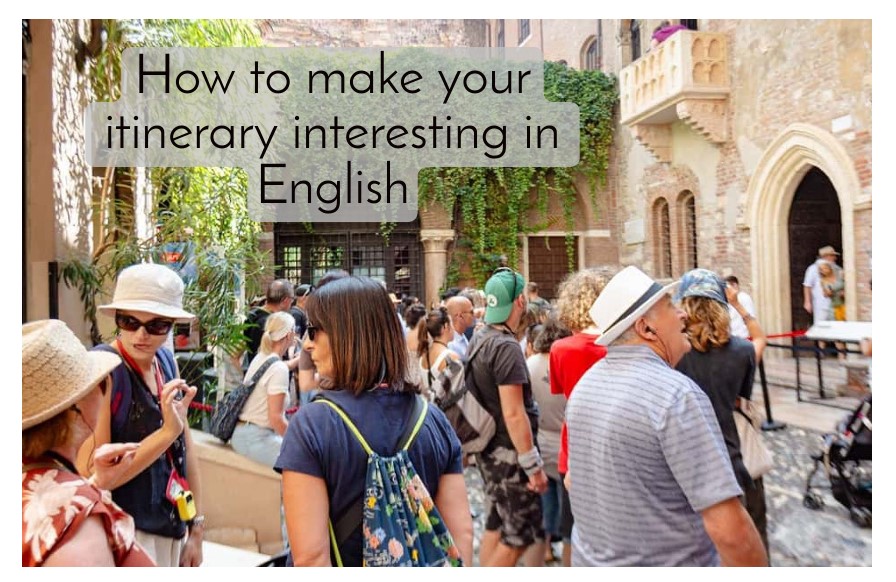
Let’s see how we can use these adjectives to make our itinerary sound more interesting and exciting. Take a look at how the Piazza delle Erbe (pictured above) is described in the itinerary for our tour of Verona.
After that, we’ll head to Piazza delle Erbe, Verona’s oldest square, where you can admire the beautiful architecture and lively market. You’ll have some free time to explore and perhaps grab a coffee or a gelato.
The tour guide tells the group four things about the place that they are going to visit.
- What its name is
- What it is
- What you can see there
- What you can do there
The first three of these pieces of information neatly fit into one sentence. The tour guide adds detail about the Piazza delle Erbe in two ways. Firstly, he uses commas (,) to briefly explain what the Piazza delle Erbe is. Secondly, he tells the group what they can see using a relative clause starting with where to talk about a place where something happens. We can use which to explain what a landmark is. Let’s have a look at an example about the Arena di Verona.
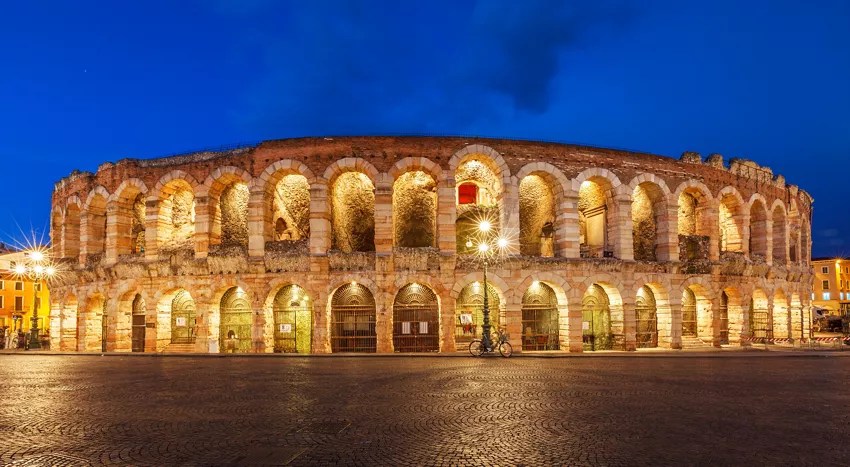
Today, we’ll start with a visit to the iconic Arena di Verona, which is one of the best-preserved ancient Roman amphitheatres.
Don’t forget to pause!
As you can see, there are also commas before the relative pronouns (where and which) because we are adding extra information about each landmark, which helps you to know when to pause and take a breath when you are speaking.
Try it!
Try reading the description of the Piazza delle Erbe out loud twice. Firstly, read it all the way through without pausing. Now, read it again and pause where you see commas or full stops (.).
Notice how much easier it is to speak fluently if you have natural pauses in your speech. It’s also easier for your tour group to follow what you are saying when they listen to you. By the way, this is true in your language too!
In this article we’ve looked at
- Adjectives that are useful for describing places on your itinerary.
- A structure that helps you to make your itinerary more interesting
- How to add detail to your description of landmarks
- The importance of natural pauses when we are speaking
Try it!
Using what you have learnt in this article, introduce a landmark on your tour itinerary using the structure that we saw earlier. Try using these ideas to make your itinerary more interesting and exciting next time you give an overview of it to a tour group.
Let me know how you introduce the places on your tour itinerary. I’d love to hear from you. You can email me at nji.swerdlow@gmail.com or book a time to have a chat with me using the link below.
I hope you’ve found this article useful. If you have, please like it, subscribe for more articles like it, and if you think it would help a friend or colleague, then share it with them. I’d really appreciate it!
What else can I do to help you?

If you’d like to make your English tour more engaging, then let me tell you about Guide better tours in English, an English course especially for busy tour guides.
How I can help you to improve your English tours
Many tour guides that I’ve met find it difficult to get their tour groups engaged and interested on their guided tours in English. As a teacher, I understand the importance of knowing that your group have had an interesting experience and have learnt something new.
Guide better tours in English is an English course that helps you to give interesting tours in English that your tour groups feel involved in.
Busy?
I know you’re busy, so Guide better tours in English fits into your working week by combining supported learning in your own time with 1-to-1 sessions with me to prepare your English tours and learn from them afterwards.
Where can I find out more?
You can find out more on my website or book a time to have a chat with me. It would be great to speak with you.
Start learning for free!
The best way to know if a course is right for you is to try it, so here is a free lesson from Guide better tours in English so that you can see for yourself.
 Nick Swerdlow
One thought on “Tour guides: How to introduce your tour in English”