
Writing a logline for a film project can be challenging, especially if you need to write it in a foreign language.
This is the second of a series of articles on how to structure loglines in English. Last time we looked at how to play with constituent parts to form a logline, and how to introduce the inciting incident in English. If you haven’t done so yet, I highly recommend reading the first article before moving on to this one.
This time we’re going to focus on structuring the protagonist’s goal.
What’s the protagonist’s goal?
Last time we used the logline from Finding Nemo to understand the different parts of a logline. Here’s a quick reminder.
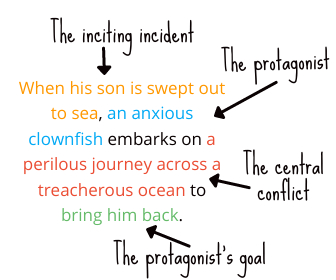

What does it mean?
Be swept out to sea: The strength of the sea carries him further out into the sea
Embark on something (verb): Start doing something new, exciting or difficult. For example you can embark on a journey or a new career
Perilous (adjective): Something that is very dangerous. For example, a perilous journey, a perilous mountain pass
Treacherous (adjective): Something that is very dangerous and unpredictable. For example, treacherous weather conditions, treacherous waves at sea, a treacherous stretch of the journey
In our example, the protagonist, or the main character, is an anxious clownfish. The protagonist’s goal is his overall aim in the film, which in this case is to bring back his son.
Introducing the protagonist’s goal
In the original Finding Nemo logline, the protagonist’s goal appears at the end of the logline as the reason for embarking on a journey across the ocean.
When his son is swept out to sea, an anxious clownfish embarks on a perilous journey across a treacherous ocean to bring him back.
You can see that the protagonist’s goal takes the verb form ‘to + infinitive’. We use ‘to + infinitive’ to give the reason of doing something. Here are some more examples.
- Back to the future: He went back in time to reunite his parents
- Elf: He ventures outside the North Pole to find his biological father
Try it!
Use to + infinitive to write the protagonist’s goal for your film project as the reason for doing something using the following structure: The protagonist does X to + infinitive + the protagonist’s goal.
A quick look at our alternative logline for Finding Nemo shows that certain verbs and nouns are often used to introduce the protagonist’s goal.
An anxious clownfish endeavours to bring back his lost son without succumbing to the perils of a treacherous ocean during his journey.
Some of these words, like endeavour, are about attempting to do something, while others are about deciding to it, wanting to do it, or doing it out of necessity or responsibility. Here are some examples of each. Can you guess what the films are from the loglines? The answers are below!
Attempts
- A widowed new dad copes with doubts, fears, heartache and dirty diapers as he sets out to raise his daughter on his own.
- A small-time boxer gets a supremely rare chance to fight a heavy-weight champion in a bout in which he strives to go the distance for his self-respect.
Decisions
- A depressed suburban father in a mid-life crisis decides to turn his life around after becoming infatuated with his daughter’s attractive friend.
- An insurance salesman determines to claim his right to a real life when he discovers that his whole life is actually a reality TV show.
Necessity
- A young F.B.I. cadet must confide in an incarcerated and manipulative killer to receive his help on catching another serial killer who skins his victims.
- A young janitor at M.I.T. has a gift for mathematics but needs help from a psychologist to find direction in his life.
Responsibility
- When a killer shark unleashes chaos on a beach community, it’s up to a local sheriff, a marine biologist, and an old seafarer to hunt the beast down.
- A pragmatic paleontologist touring an almost complete theme park on an island in Central America is tasked with protecting a couple of kids after a power failure causes the park’s cloned dinosaurs to run loose.
Wants
- Several historical events from the 20th Century unfold from the perspective of an Alabama man with an IQ of 75, whose only real desire is to reunite with his childhood sweetheart.
- Over the course of several years, two convicts form a friendship, seeking consolation and, eventually, redemption through basic compassion.
Did you guess the film?
Attempts
- Fatherhood
- Rocky I
Decisions
- American Beauty
- The Truman Show
Necessity
- Silence of the lambs
- Good Will Hunting
Responsibility
- Jaws
- Jurassic Park
Wants
- Forrest Gump
- Shawshank Redemption
How to use it
Have you noticed that each of these phrases to introduce the protagonist’s goal has a certain pattern? The pattern for ‘endeavour’ is
- endeavour + to infinitive
Can you see any other phrases in the loglines above with the same pattern?
Here are the patterns for the phrases in our above loglines as well as a few other related phrases.
| Verb/ Phrasal Verb + to infinitive | Verb + infinitive | Verb/ Phrasal Verb + object + to infinitive | Noun + is + to infinitive | be + past participle + preposition + verb+ing | Verb + noun | |
| Attempts | Endeavour Attempt Try Strive Set out | |||||
| Decisions | Decide Determine | |||||
| Necessity | Need | Must | Need | |||
| Responsibility | Be up to | is tasked with | ||||
| Wants | Desire | Desire | Seek |
Try it!
Have a think about the protagonist in your film project. Which of the above categories best describes the reason for your protagonist’s goal? Now try to write the protagonist’s goal for your film project. Feel free to share it with me if you would like some support to perfect your logline in English. I’d love to read it. You can email me at nji.swerdlow@gmail.com.
You can learn more about how to write your loglines in How to Pitch Your Project in English, the English course that helps you to make the most of your opportunity to pitch your film project. If you would like support with your English to get ready for a specific opportunity then why not find out more about English Consultation Sessions.
Do you need to pitch your film project in English?

Are you a film producer, director, or scriptwriter who would like international support to fund, distribute or collaborate on your film projects?
How to pitch your project in English is a specialised one-to-one English course that helps you to get your film project off to the best start by pitching your film projects more effectively and confidently in English. In two months you can learn the skills that you need to request a pitch meeting, pitch your film project, and follow up on your pitch.
If you’d like to know more about How to pitch your project in English, then send me a message or click on the link below.
I hope you found this blog post useful. If you think that it would help a colleague then why not share it with them. Let me know about your experience of writing loglines or pitching film projects. I’d love to hear from you.

 Nick Swerdlow