
English grammar for writing loglines part 1: the inciting incident
If you have pitched a film project before the chances are you’ve had to write a logline in your own language. Today we are going to talk about how to structure loglines in English.
A logline is your first opportunity to introduce your film project to a decision-maker such as a producer or a studio executive and to capture their interest in it. If someone asks you what your film is about, your logline is your most succinct answer. You can go into more detail later in your conversation.
The skill of writing a logline is to find the essence of your film project and summarise it in one or two sentences in a way that the listener will immediately understand and engage with. Writing an attention-grabbing logline is challenging in our own language, let alone in another language. So, let’s look at the English that we need to write a strong logline.
The elements of a logline
Most loglines include the following elements:
- the protagonist: who the main character is
- the inciting incident: the event that sets up the main premise of the film
- The protagonist’s goal: what the protagonist is trying to do
- The central conflict – The obstacle that makes it difficult for the protagonist to achieve his/her goal.
Let’s see how these elements fit into a logline.
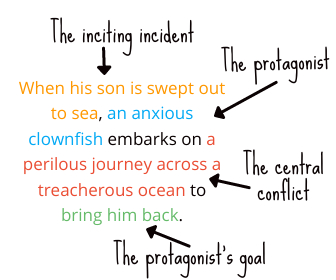

What does it mean?
Be swept out to sea: The strength of the sea carries him further out into the sea
Embark on something (verb): Start doing something new, exciting or difficult. For example you can embark on a journey or a new career
Perilous (adjective): Something that is very dangerous. For example, a perilous journey, a perilous mountain pass
Treacherous (adjective): Something that is very dangerous and unpredictable. For example, treacherous weather conditions, treacherous waves at sea, a treacherous stretch of the journey
Structuring our logline
The Finding Nemo logline follows the below structure:
When (the inciting incident) happens (the protagonist) overcomes (the central conflict) to achieve (the protagonist’s goal).
By putting the inciting incident at the start of the logline, we are emphasising it. However, other structures are possible. Compare it to this alternative logline
An anxious clownfish endeavours to bring back his lost son without succumbing to the perils of a treacherous ocean during his journey.
What does it mean?
Endeavour to do something (verb): to try hard to do something. For example, he endeavoured to find a permanent solution to the problem.
Succumb to something (verb)
What do you think of our new logline? This time we’ve put the protagonist and his goal at the front. The central conflict is treated as a risk that the protagonist must avoid, and the inciting incident is implicit in the adjective ‘lost’. The structure is
(The protagonist) attempts to achieve (the protagonist’s goal) without becoming a victim of (the central conflict) .
You can see that reorganising the elements of a logline gives us a lot of possibilities to consider.
Try it!
Can you reorganise the elements of the Finding Nemo logline to make a new logline?
Bricks and mortar

If the elements of a logline are the bricks, then the words that introduce each of the elements form the mortar that holds the bricks in place. To give you an idea of what sort of words these are, let’s look at our Finding Nemo examples.
| Mortar | Brick (the inciting incident) | Brick (the protagonist) | Mortar | Brick (the central conflict) | Mortar | Brick (the protagonist’s goal) |
| When | his son is swept out to sea, | an anxious clownfish | embarks on | a perilous journey across a treacherous ocean | to | bring him back |
| Brick (The protagonist) | Mortar | Brick (Protagonist’s goal/inciting incident) | Mortar | Brick (The central conflict) |
| An anxious clownfish | endeavours to | bring back his lost son | without succumbing to | the perils of a treacherous ocean during his journey. |
In this blog we are going to focus on introducing the inciting incident. Keep an eye out for future blogs to learn more about how to introduce the protagonist’s goal and the central conflict in English.
Introducing the inciting incident

In our logline, the inciting incident is introduced by ‘when’ followed by the present simple passive.
- When his son is swept out to sea….
We could also introduce the inciting incident using ‘after’, or ‘once’ followed by the present simple. Here are some examples
| – When – After – Once | an anxious clownfish | (suddenly) | – realises that – discovers that – finds out that | his son has been swept out to sea, |
As you can see, we can either introduce the inciting incident itself or the protagonist finding out about it. Using adverbs can help us to suggest the tone of the project. The use of ‘suddenly’ brings a sense of immediacy.
The inciting incident can also be implicit from the context or implied by an adjective such as the use of ‘lost’ in our alternative logline. This can free up space to talk about the protagonist’s goal and the central conflict, as in the logline for Fatherhood (2021) below:
A widowed new dad copes with doubts, fears, heartache and dirty diapers as he sets out to raise his daughter on his own.

What does it mean?
Widowed (adjective): Describes a person whose wife or husband has died. A man whose wife has died is a widower. A woman whose husband has died is a widow.
Cope with (verb): To manage a difficult situation successfully. For example, He coped admirably with bringing up a child as a single parent
A diaper (US, noun): Disposable underwear for babies. British English: A nappy. For example, I’m going to go and change her diaper.
In this logline, ‘widowed’ is enough to tell us what the inciting incident is. Spending more words on the death of the protagonist’s wife would change the focus of the logline. This is a good example of why it’s important to use words sparingly in a logline and make every word count.
Try it!
How explicit should the inciting incident be in your logline? Try writing the inciting incident for one of your film projects or a film that you know well.
Feel free to share it with me if you would like some support to perfect your logline in English. I’d love to read it.
You can learn more about how to write your loglines in How to Pitch Your Project in English, the English course that helps you to make the most of your opportunity to pitch your film project. If you would like support with your English to get ready for a specific opportunity then why not find out more about English Consultation Sessions.
Do you need to pitch your film project in English?

Are you a film producer, director, or scriptwriter who would like international support to fund, distribute or collaborate on your film projects?
How to pitch your project in English is a specialised one-to-one English course that helps you to get your film project off to the best start by pitching your film projects more effectively and confidently in English. The course is made up of 15 personalised lessons that help you to learn the skills that you need to request a pitch meeting, pitch your film project, and follow up on your pitch.
If you’d like to know more about How to pitch your project in English, then send me a message or click on the link below.
I hope you found this blog post useful. If you think that it would be useful for a colleague then why not share it with them. Let me know what you think and about your experiences of pitching film projects in English. I’d love to hear from you.

 Nick Swerdlow
One thought on “How Finding Nemo can help you to write loglines in English”