I’d like to give you some ideas about how reading and listening in English can help you to talk about filmmaking in your job as a professional in the film industry. I’ll also tell you about The English Filmmaking Conversation, an opportunity for you to practise talking about filmmaking and develop your professional English.


Do you need to talk about filmmaking in English? In an increasingly international industry, many professionals need to have conversations about filmmaking on international projects or at film festivals.
Talking about making films is really interesting, but it’s also a really specific topic to be able to talk about well if English isn’t your first language. For example, most English classes at school don’t teach you how to talk about post production, which brings us to the question, how can we improve our ability to talk about filmmaking in English.
Learn from the best

Let’s start by looking at what good language learners do. Have you ever noticed that some people seem to have the ability to make language learning look easy? How do they do it? Well, most of them
- read or listen a lot in the language
- take an interest in new language, and make guesses about what it means and how to use it
- and take opportunities to speak to people in the language about topics that are useful and interesting to them
Listening and reading about filmmaking in English not only improves your filmmaking knowledge, it also improves your English. There’s a lot that you can do independently to learn from what you read or listen to. Here are some ways that you can turn reading and listening into language learning opportunities:
- Write or record a summary of what you have read, watched, or listened to: This is a great way to check how much you understand and reuse some of the language that you have noticed. If you want to practise your pronunciation then record yourself summarising the article, video or podcast. When you’ve finished, check your summary against the original. How well did you understand it? Were you able to correctly reuse some of the language that you read or listened to in your own sentences? Did the writer express the same ideas to you in different ways?
- Write and answer discussion questions: Once you feel that you understand what you’ve read or listened to, try to relate it to your own experiences or give an opinion on it. A good way to do this is to write your own discussion questions and then practise answering them in English. You could make questions like…‘Do you agree with the speaker’s opinion on…(the advantages of filming on location?)’ or ‘How similar was your experience of…(getting started in the film industry) to the writer’s?
- We’d like to interview you, please: There are a number of good podcasts where filmmakers are interviewed. Listen to an interview with a filmmaker. Listen to the question and the answer, and then press pause. Now, answer the question for yourself like you are being interviewed. If the question doesn’t relate perfectly to your situation then change it slightly. This is a great way to practise expressing an opinion on a filmmaking topic, and giving reasons for your opinion. You can also comment on the answer that you’ve just heard. If you find it difficult to express your thoughts then go back and listen to how the filmmaker in the interview talks about similar ideas in English.
I hope you find these activities useful. Let me know what you read and listen to, and how you use these blogs, videos and podcasts to practise your English. I’d love to hear from you.
I can help you to improve your filmmaking English and practise talking about filmmaking more effectively. If you’d like to know how, read on.
The English Filmmaking Conversation
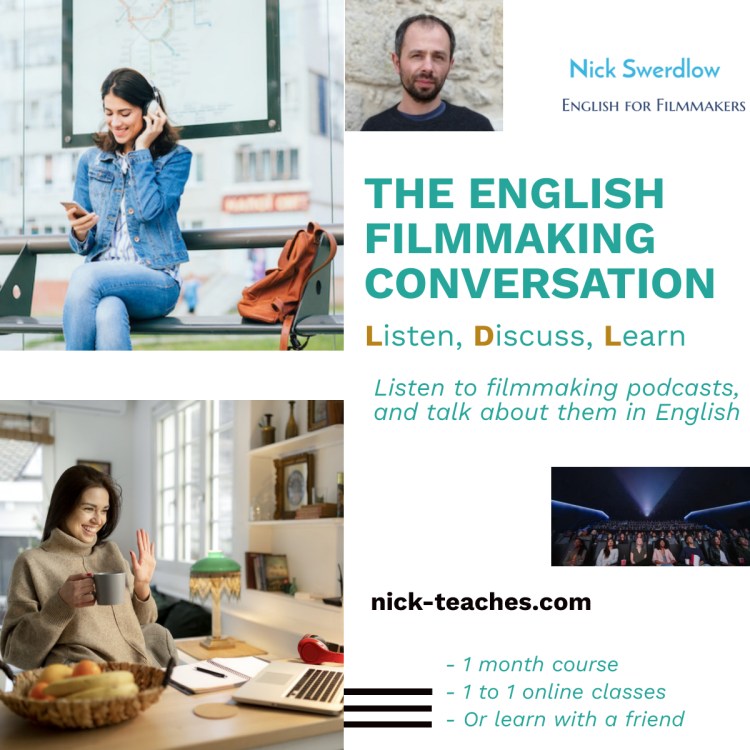
The English Filmmaking Conversation is your opportunity to
- Enjoy discussing interesting filmmaking topics in English
- Listen to in-depth interviews with filmmaking professionals, and learn English from them
- Practise listening and speaking in English about filmmaking topics
So, how does it work?
You can join the English Filmmaking Conversation for 1-to-1 sessions, or for small group sessions with a friend or colleague. Here’s what happens:
- You listen to part of an interview with a filmmaker from a podcast in your own time. You’ll also get a worksheet with activities to help you to understand the interview, and discussion topics to think about
- We meet and talk about the interview, the English in it, and the filmmaking topics relating to it. This is your chance to practise speaking and to learn from the English that we use.
Each week you’ll receive the next part of the same interview to listen to, and we’ll meet to talk about it. There are 4 parts to each interview.

The first interview is with David Oyelowo, a really interesting and thought-provoking actor and director.
I can’t wait to discuss interesting filmmaking topics with you such as
- the challenges of getting funding for projects,
- and the best advice you received when you were starting out in your career
Start listening for free
Click on the link above to listen to part 1 of the interview using the worksheet to help you.
If you’d like to know more about the English Filmmaking Conversation, then book a time to have a chat with me. It would be great to hear from you.
 Nick Swerdlow