
There’s a lot of pressure on the start of a film pitch.
You need to grab people’s attention quickly, and a complicated set up won’t engage your listeners in your pitch. So, where do you start? Michael Hauge recommends beginning by talking about how you came up with the idea for the film project in the first place. Here’s Spike Jonze, the scriptwriter, director and co-producer of Her (2013), talking at the start of the video about how the idea for the film came to him.
Real English: Come up with something
To come up with something means to think of an idea or a plan for something.
You can come up with
- an idea
- a plan
- a storyline
- a title for a film
- a solution to a problem
Example: I’ve come up with an idea for an interesting twist in the plot.
Try it!
What film or TV ideas have you come up with recently?
Real English: Get a buzz
Spike Jonze said that the idea for Her was based on the buzz that he got from talking to an artificial operating system in the first 20 seconds.
What is a buzz?
A buzz is a pleasurable feeling of excitement and energy that we get from doing something.
How is it used?
Get a buzz out of + verb + ing (exciting activity)
Example: I get a buzz out of seeing my film ideas come to life.
Try it!
What exiting activities do you get a buzz out of doing?
As you can see, this story helps Spike Jonze to show that his film relates to our modern lives. You might also notice that he talks quite engagingly about the concept of the film because the idea clearly caught his interest from the start. As well as being a common question when being interviewed by the media, this also works as a pitching strategy for three reasons.
- Firstly, it provides an easy pathway from the small talk at the start of your pitch meeting to actually pitching your film, avoiding any sense of a sharp cut between finishing small talk and giving your pitch.
- Secondly, it puts the idea for the film into the context of a lived experience. Imagine a pitch for Her that starts like this ‘Imagine, a man falls in love with his artificial intelligence operating system….’. Without any sort of context, the plot would sound contrived. The most natural context for a film is how you came up with the idea to begin with.
- Thirdly, explaining how you thought of the idea helps you to show your passion for the film quickly because it allows you to talk about what made you first think it was a good idea for a film. As you can see from the video, this makes it easier to talk naturally, engagingly, and with conviction.
Starting your pitch

So, here is what the start of a pitch for Her might look like based on how he came up with the idea for the film.
I think that the best way to tell you about my film project is to tell you how I came up with the idea for it. A while ago I was reading an article, and it had a link to a site where you can talk to one of those artificial intelligence computer programmes, so I tried it and for the first 20 seconds it felt just like having a chat with a real person, and I started thinking what if a man falls in love with his computer operating system...
Pitching in English
Let’s have a look at the English that we can use to start your pitch in a similar way.
“I think that the best way to tell you about my film project is to tell you how I came up with the idea for it.“
The first sentence is important because it signals to the decision-maker how we are going to approach our pitch.
“A while ago I was reading an article and it had a link to a site where you can talk to one of those artificial intelligence computer programmes, so I tried it and for the first 20 seconds it felt just like having a chat with a real person…”
When did it happen?
The second part tells a short story about the incident that led to the idea for the film project. People usually start anecdotes with a time reference like
- A while ago
- A few months ago
- Recently
- Last year
Verb tenses: telling a story about how the idea came to you
In our pitch, the story of what he was doing when he thought of the idea is in past continuous (I was reading…), and past simple (it had a link…, I tried it…, it felt just like...). We often use these tenses together to tell anecdotes about things that have happened to us.
- Past continuous tells us what we were doing in the past when an important event or action happened, which gives the context to your story. For example:
- A while ago I was reading an article and it had a link to a site where you can talk to one of those artificial intelligence computer programmes…
- I was waiting for my daughter outside her school…
- I was at a dinner party and a French guy was telling me about his difficulties in making friends as an adult in a new country…
- Past simple tells us the main action or event in your story. When you explain how you thought of the idea for your film project, this will often be a thought or a feeling.
- A while ago I was reading an article and it had a link to a site where you can talk to one of those artificial intelligence computer programmes, so I tried it and for the first 20 seconds it felt just like having a chat with a real person…
- I was waiting for my daughter outside her school, when just for a moment I thought what if she doesn’t come?
- I was at a dinner party and a French guy was telling me about his difficulties in making friends as an adult in a new country, which made me wonder why integrating is so difficult for adults and whether it would be true for people integrating into other cultures.
As you can see from this last example, this strategy could be used for pitching documentaries as well as fiction.
Note: Past continuous and past simple are really useful for telling a story about something that happened, but you don’t need them to explain the plot of your film project. Plots are normally told using present simple. You can see this in the last part of the start of our Her pitch.
“and I started thinking what if a man falls in love with his computer operating system…”
The phrase ‘and I started thinking what if…’ helps us to lead our anecdote about coming up with the idea for the film into our actual pitch. It shows your interest in the concept of the film project and helps to raise the interest of the decision-maker.
Try it!
How did you come up with your most recent idea for a film project?
- What were you doing when the idea came to you?
- What idea did you have?
- How did this idea lead you to a concept for a film project?
Let me know how you get on with your film pitch. I’d love to hear about it. If you found this blog post useful, please like it or leave a comment.
If you would like to pitch your film projects in English more effectively, then read on to find out more about the How to Pitch Your Project in English, the English course that helps you to make the most of your opportunity to pitch your film project.
Do you need to pitch your film project in English?
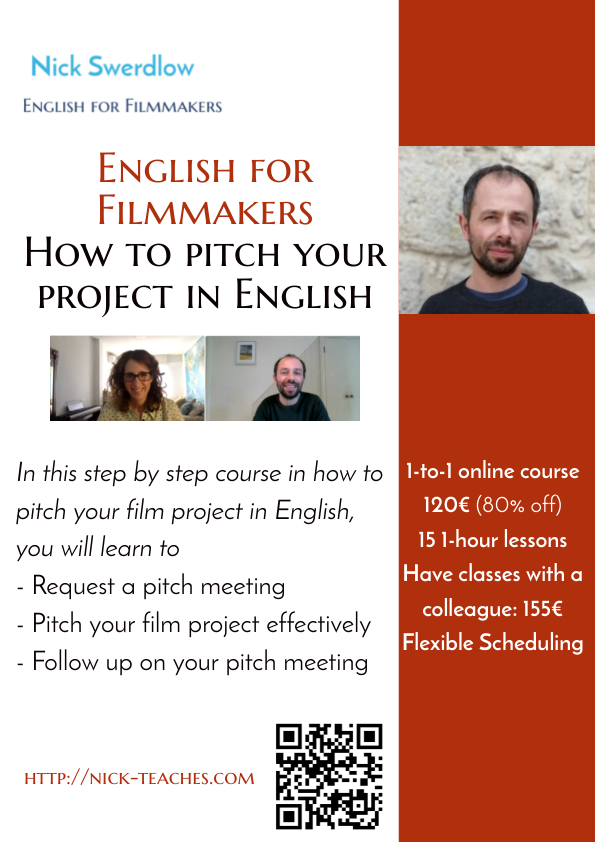
Are you a film producer, director, or scriptwriter who would like international support to fund, distribute or collaborate on your film projects?
How to pitch your project in English is a specialised one-to-one English course that helps you to get your film project off to the best start by pitching your film projects more effectively and confidently in English. The course is made up of 15 personalised lessons that help you to learn the skills that you need to request a pitch meeting, pitch your film project, and follow up on your pitch.
If you’d like to know more about the How to pitch your project in English, then send me a message or click on the link below.
A little about Nick

As a highly-qualified and experienced English teacher I work with learners to enable them to express their ideas effectively in English when it matters, so that they can make the right impression in meetings and conversations. It gives me huge satisfaction to see the progress that my learners make.
I’ve always been a film fan, and teaching filmmakers has been a fascinating insight into the film industry, which has given me an understanding of the language skills that you need to perfect your film pitch in English.
Working as an independent teacher with my own teaching enterprise has taught me the importance of understanding learners’ needs and aims, and ensuring that my messaging talks to those aims. In the same way, your messaging in your meeting needs to talk to the aims of the person in front of you. Together, we can perfect your message so that you can be effective and confident in your English pitch-meeting.
 Nick Swerdlow